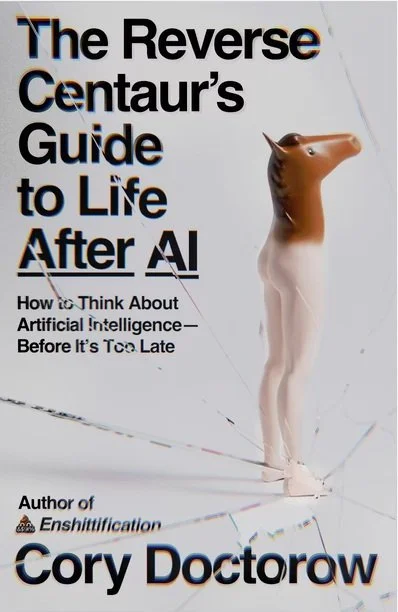
The Reverse Centaur’s Guide to Life After AI: How to Think About Artificial Intelligence - Before It’s Too Late
Cory Doctorow, 2026
MacMillan
Review by Jacob Pleasants
In media appearances about his most recent book, you will often hear Cory Doctorow say the following: “The most important thing about a technology isn’t what it does, it’s who it does it for, and who it does it to.” It’s a quote from his book, and it’s also a pretty good encapsulation of arguments that Doctorow has been making about technology for a very long time. As both a writer of science fiction and a technology critic, a central theme in Doctorow’s work is that the effects of technology are largely a function of power: who has the power to decide how technologies are designed and used. When power lies in the hands of authoritarian governments, authoritarian bosses, or capitalist companies, the outcomes are not great for the rest of us. Doctorow made that case in The Internet Con and Enshittification [1], and in The Reverse Centaur’s Guide to Life After AI he brings that central thesis to the specific case of this latest technological craze.
It’s important to note the continuity in Doctorow’s work. When he approaches the case of AI, he is not treating it as some epochal technology that requires radically new ways of thinking. To the contrary, the conceptual tools that we need for AI are largely the same ones we’ve needed for other digital technologies (that’s not to say that our society has necessarily done a bang-up job with those technologies). AI raises some new problems and puzzles, but they aren’t radical departures from what we’ve encountered in the past. In many ways, then, this book is an application of Doctorow’s prior ideas. If you’ve read his previous work, there will be many familiar themes and principles. If you haven’t, don’t worry, he presents them as needed.
On Centaurs and Reverse Centaurs
This is the central image of the book. A centaur is a human-technology arrangement in which the technology enables the human to carry out their tasks, often in a work context. It’s what we most often imagine when we think of humans using technologies as “tools.” I use my glasses to see the world, I use a tea kettle to boil water, etc. A reverse center is the opposite arrangement, in which the human enables the technology to carry out its tasks. Think of the assembly-line worker who performs physical operations to keep the production machine moving, or the human translator who cleans up an AI’s barely-passible translation output. These reverse centaurs are being used by the machine, and Doctorow further argues that they are often used up in the process (e.g., Amazon warehouse workers and drivers).
It’s not the technology itself that causes one arrangement or another. In a work context, whether you are a centaur or reverse centaur is a question of labor relations. To the manager, employing a bunch of reverse centaurs is rather appealing. Really, the only thing more appealing is fully eliminating the human workforce. But there are usually certain tasks that are not amenable to automation, and so some humans will need to be employed to fill the cracks and smooth the edges (reverse centaurs).
Such is the manager’s dream. And such is the story that AI companies are currently telling about their technology. In fact, Doctorow argues, this is the story they pretty much have to tell, because it is what enables them to justify their absurd market valuations. To justify that high price, these companies need to convince investors that their technology is going to replace workers on a massive scale. That’s where the money is, of course. Nobody truly believes that OpenAI is going to recoup a trillion dollar investment through everyday user subscriptions to ChatGPT. The real money lies elsewhere. And it just so happens that the fantasy they are selling is one that bosses everywhere are all too eager to believe. Whether AI can actually perform anyone’s job is beside the point. Bosses will settle for being able to fire at least some of their workers and having those that remain monitor the AI and fill in the gaps as needed (i.e., be reverse centaurs). One is reminded of automated checkout lines at the grocery.
There is an Alternative
None of this is inevitable. None of this is inherent to the various technologies we collectively call “AI.” Doctorow is vehemently against the vision that these particular AI companies have put forward, and he is vehemently against the ways that companies have deployed AI technologies to screw over workers. But these are not so much technological as social, economic, and labor issues. We can have something different, but it will require breaking the power held by big tech.
This will require deflating the current AI bubble by deflating AI hype. Making alarmist proclamations about what AI might do, especially to workers, is not a winning strategy. In fact, it may unwittingly prop up the AI bubble by convincing investors that AI is indeed just as powerful as the tech companies say that it is. Those investors may not much care that what the AI companies are creating is powerfully harmful provided that it is profitable. Better, then, to call BS on the hype. No, AI cannot do the job of a truck driver, or a radiologist, or an interpreter. Bosses have certainly used AI to make many of those jobs much worse, as Brian Merchant has chronicled. But Doctorow would rather have us direct our attention at the socio-economic arrangements that enable such things rather than AI. After all, there’s nothing special about AI. It’s just the latest technology to be wielded by managers to disempower labor. Building worker power is therefore likely to yield far better and lasting results.
A Place for AI
An important part of this book, and Doctorow’s work more broadly, is that he resists being “against” AI. This is not to say that he is “pro” AI. He approaches it as a normal technology, one that has its uses as well as a host of problems.
As an author, for instance, he has little patience for those who would use generative AI to produce their work. He presents an extended argument for why the “art” produced by generative AI (whether visual or textual) is just simply bad. Yet that doesn’t mean that AI is completely useless for creatives. Doctorow uses AI to check for typos.
More broadly, Doctorow insists that the statistical modeling that underpins AI technology is pretty darn useful [2]. The existing set of AI products may very well be shitty, but that is not an inevitability. An enduring part of his philosophy is that we all ought to have far greater agency to do with these technologies what we will. Naturally, some people are going to use AI technologies in ways that we don’t much like. Some people are going to use AI to crank out mediocre “music” or “novels,” and others will use it for even less pro-social purposes. Sorting out how we respond to such things will take some doing, and it will be messy. A fair bit of Doctorow’s fiction, in fact, is an exercise in working out just how messy that all will be. The messiness, though, is kind of the point. It’s certainly a lot simpler to have powerful governments or corporations dictate what technologies we use and how we use them, but simpler is not better.
In Schools?
This brings me to the question of education and teachers. Doctorow seldom mentions the school context in his work, but his book has some real insights into the school as a workplace. It is not hard to imagine how teachers could find themselves in reverse centaur arrangements. Arguably, this is already the case for certain parts of their day. When your job is making sure that all your students are getting onto their computers to log their IXL minutes, you are a reverse centaur. Or, as described in recent studies by Wang et al. (2026) and Selwyn et al. (2025), when you are repairing and cleaning up after the buggy AI systems.
It is tempting to dismiss AI as just another useless technology that has been oversold to teachers and schools, and that is ultimately making teachers’ lives worse. But Doctorow would urge us to think otherwise before we make such a blanket proclamation. He would especially ask us to look at who is empowered to decide when and how those technologies are used. People don’t generally willingly become reverse centaurs (even if not forced outright, productivity pressures can also de facto force people into such roles). Doctorow would ask us to consider how we can more fully empower teachers to decide which technologies they want to use in their work and how. That does not mean that “anything goes.” Indeed, the logical conclusion would provide teacher education that supports autonomous decision-making rather than try to dictate what exactly those decisions will be. Some teachers may find ways to make good use of AI technologies, others might reject them. It will probably not be radically transformative, and that’s just fine.
Notes
He also makes this case in his fiction. My favorite encapsulation of his argument is the short story Unauthorized Bread.
Consider also the much-reviled “scraping” that has been used to develop language models. It sure feels wrong that the AI companies have used vast quantities of copyrighted works to train their generative AI systems. But Doctorow presents a rather compelling case for why this particular complaint is off-target and why trying to use copyright to protect against it is a bad idea. Among other things, this kind of “scraping” is what has given us things like the Internet Archive and internet search - awfully useful stuff. Doctorow argues that artists (writers, musicians, etc.) have a labor problem here, not a copyright problem.