Against Tech Hype
Join us for our 5th Annual Civics of Technology Online Conference held online on August 6th and August 7th, 2026, from 11-3 pm EST
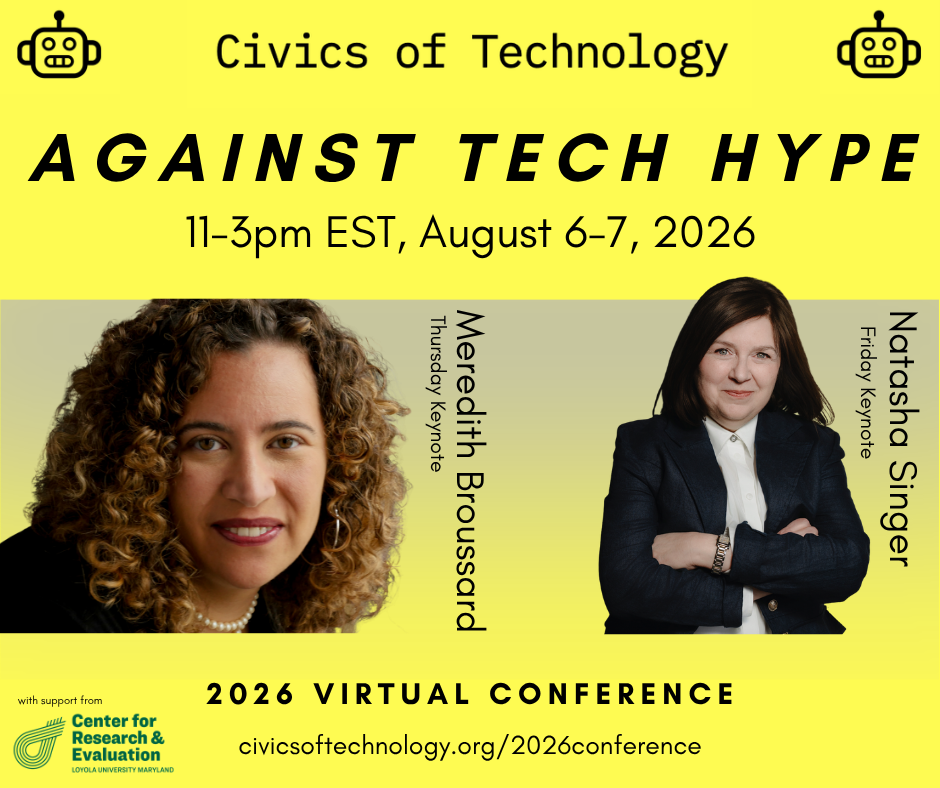
Keynote Speakers
Thursday, August 6: Dr. Meredith Broussard is a data journalist and professor at the Arthur L. Carter Journalism Institute of New York University and the research director at the NYU Alliance for Public Interest Technology. She is the author of More Than a Glitch: Confronting Race, Gender, and Ability Bias in Tech(A CoT book club book!) and Artificial Unintelligence: How Computers Misunderstand the World, and appeared in the 2020 documentary film Coded Bias. Her work provides a powerful corrective to dominant “technochauvinist” narratives. She has challenged the presumed neutrality of technology and researches AI ethics and data analysis for social good.
Friday, August 7: Natasha Singer has covered tech industry influence in schools for The New York Times for more than a decade. Her early reporting on school tech helped prompt California to enact the Student Online Personal Information Protection Act (SOPIPA), a landmark student privacy law. This year she is reporting on how tech giants like Google and OpenAI are driving A.I. adoption in schools while teachers are working to equip students to ask deeper questions about the societal impacts. Her recent work includes stories about the tech backlash in schools, teens’ use of AI chatbots, and efforts to promote AI literacy. Her forthcoming book, "Coding Kids: Big Tech's Battle to Remake Public Schools," will be published by W.W. Norton in September. (We will be hosting a book club for it!)
Support the Conference!
As in previous years, our organization is fully committed to making our conference free to all.
But for those who are able and willing, we would greatly appreciate financial support from our community. If you are willing and able to support our conference and our ongoing work, please consider doing so here.
Donations help us to:
Provide stipends to our conference keynote speakers
Pay the overhead costs of our online platforms
Offer additional events for our community (e.g., digital film screenings like our recent Ghost in the Machine event)
We will always be transparent about how donations are spent and you can see our financial reports on our website.
Conference Norms
Please be patient listeners, understanding that our positionalities in relation to power influence our interactions, and recognize that impact matters more than intent. Attendees should respect the preferences and dignity of fellow conference participants, including at the conference. Please use pronouns if listed and respect the social media sharing preferences of presenters (e.g., do not share without consent). Our conference also aims to be accessible and all sessions should turn on the option to “show captions.” Moreover, we hope participants will commit to advancing more just futures. Please contact Dan, Marie, or Jacob or use our contact form if you have any problems or concerns during the conference.
Day 1 — Thursday, August 6th
11:00-11:10am EST
-
Room 1
Welcome & Introduction to the Conference
Community Building Activity
Dan Krutka, Marie Heath, & Jacob Pleasants
Day 1 Keynote | 11:10-12:00pm EST
-
Keynote: Meredith Broussard
12:05-1:00pm EST
-
Room 1
“What is AI made of?” and other unplugged, critical AI literacy activities
Heidi Reed
In the spirit of digital sobriety and Luddite praxis, this session provides examples of digital device free activities I used in an "AI Ethics Unplugged" faculty workshop and have also used in my classroom. Though they are designed to be low-tech, you can also adapt them for online learning.
Naming the Feeling Rules of AI Hype, Interrupting the Inevitability Narrative
Andrea (an-dree-uh) Baer, PhD
Drawing from critical hype studies and building on previous work on the feeling rules of Generative AI (social expectations about how to feel and emote about AI), I examine hype as a rhetorical tool of power that works to shape narratives, beliefs, and emotions, reinforcing a currently dominant AI inevitability narrative and amplifying certain voices while muffling others. I argue that deepening our understandings of hype as a tool of power and a shaper of affect, and recognizing the increased role of “critical washing” (Suarez et al., 2025) in AI hype, can help us reclaim greater individual and collective agency to engage in critical conversations and decision making about AI technologies in and outside education.
-
Room 2
Between a Digital Scylla and Charybdis
Ellie Dimopoulos
Privacy is a community practice, not a skill issue. This session introduces fifteen conversation cards for students, faculty, and patrons alike: small, repeatable conversations that build real skill and confidence over time.
Algorithmic Electability: Generative AI, LGBTQ Candidates, and the Reproduction of Political Bias
Zachary Baum
This session examines whether generative AI systems reproduce, mitigate, or transform biases toward LGBTQ political candidates. Drawing on original experimental evidence, it explores how AI-generated assessments of candidate electability may shape democratic representation and political gatekeeping.
-
Room 3
Imagining and Making Just Technological Futures
Isabella (Isa-bell-ah) Bruno (Br-oo-no)
Tech hype works by making one future feel inevitable. In this workshop, participants use design fiction — speculative artifacts like fake memos, newsletters, and policy documents — to inhabit and articulate the democratic, ethical, and just technological futures that the Civics of Technology project is working toward.
1:05-2:00pm EST
-
Room 1
Who Owns the Future? A Lesson for Middle School Students
Elizabeth Bacon
From Star Trek to Avatar to Project Hail Mary, popular fiction is full of competing visions of humanity’s future. These stories often showcase fantastical technologies that promise to transform the way we live, but they also embed our assumptions about identity and social structure, shaping our conception of what is possible or even inevitable. This lesson invites middle school students to question the assumptions underlying various popular visions of the future, analyzing the role technology plays in promoting these visions, and to take back the narrative by imagining their own best future.
Brains over Bots: AI’s Impact on Cognition
Vinnie Wengert
We will explore how using artificial intelligence can impact the cognitive processes that are the foundation for flexible, goal-directed behaviors (otherwise known as executive function) and how intentionally building up and deploying executive function strategies can make students better and safer AI users.
-
Room 2
What States Tell Teachers About AI
Cody Dalton
This presentation examines official K-12 artificial intelligence guidance issued by state education departments across the United States. It asks what these documents tell teachers about AI, what risks they emphasize, and what civic questions remain underdeveloped when states frame AI mainly as a tool for classroom use.
Support for who? Examining AI Governance in Minnesota K-12 Districts
Seeun (Tina) Jeon
This session presents a content analysis of AI policies across thirty Minnesota K-12 school districts, examining how tech industry hype—from workforce readiness to 21st century skills—is reshaping the governance of teaching and learning. Beneath the hype, teachers are under full responsibility for managing AI in their classrooms while being systematically excluded from the governance structures that determine how AI enters schools.
-
Room 3
Voices from the Caregiver Resistance to EdTech
Charles Logan
Alexandra Thrall
Lila Byock (LEE-luh BYE-ock)
Kelly Clancy
Chad Hamilton
Join three caregivers challenging edtech in K-12 education as we reflect on their everyday practices, discuss what it feels like to engage in this labor, and learn from one another in the struggle to redefine when, why, and to what ends technology is used in schools.
2:05-3:00pm EST
-
Room 1
Ghosts in the Archive: The Burden of Representation
Amy Allen
David Hicks
Generative AI can create persuasive historical voices and images that blur the boundaries between evidence, imagination, and memory. Drawing on the concept of the algorithmic palimpsest, this session examines the ethical challenges of historical representation and the democratic consequences of AI-generated pasts.
Slow Information Practices: Countering the Manufactured Sense of Urgency for Quick Answers
Andrea (an-dree-uh) Baer, PhD
Mandi Goodsett (man-dee good-set)
As educators teaching research and information literacy, how do we respond to sociotechnical developments in a culture in which speed and commercial interests are often prioritized over public good, critical thinking, and good research practices like sourcing? Drawing from principles of the slow movement and slow teaching, the presenters share a conception of “slow information literacy” that challenges the privileging of speed, quick answers, and currently hyped digital technologies (like generative AI) and that instead fosters more reflective, intentional, and critical engagement with information and with the online environments in which people encounter, share, and produce information.
-
Room 2
Cultivating A11y-ship Among Preservice Teachers
Dr. Natalie L. Shaheen
Dr. Shaheen will share open educational resources the A11y in Sci team created to cultivate a11y-ship for disabled students among preservice teachers, and offer suggestions about how teacher educators could use them.
Intention Meets Practice
Dr. Aaron R. Gierhart
This session highlights how preservice teachers engaged in public-facing work—such as producing group podcasts and contributing to a published student journal—while critically examining AI and educational technology and navigating the gap between intention and practice.
-
Room 3
Artful Deception: One University's Roll-Out of a (Failed) AI Tool
Dr. Sue Kasun (Caw-sun)
Dr. Erin Anderson
Three unwitting AI-early adapter faculty in good faith applied to adopt a new university AI tool in their classes. However, the university came up short on the tool's promise. Fallout from the university pilot is explored in this session.
Using a Minimal Computing Framework to Re-Imagine EdTech
Lee Skallerup Bessette
The workshop will present the concept of minimal computing and then invite participants in groups to come up with a minimal computing EdTech solution. Participants will leave with a new framework for thinking about EdTech specifically and technology more generally.
3:05-3:30pm EST
-
Civics of Technology Awards and Announcements
Join us to hear about exciting new things from our organization (e.g., new curriculum, events) and recognize our first recipients of the Civics of Technology Award for Public Scholarship
3:30-4:30pm EST
-
Black Inventors Inquiry: An Interactive Workshop on Critically Teaching about Black History and Invention
Alexander G-J Pittman, Daniel G. Krutka, & Danetra King
The Black Inventor’s Curriculum is an inquiry lesson where students seek to answer the compelling question, what lessons should we learn from the lives of Black inventors? On the homepage participants will have find brief biographies of Black Inventors. They can then click on the “Learn More” button to review a page of primary and secondary sources for each inventor. These sources will help better understand their full lives, not just their inventions. Some pages will also include sources of related inventions or helpful information to better understand their historical context. This inquiry can be modified for students from elementary to higher education and is well suited for the integration of science activities.
Day 2 — Friday, August 7th
11:00-11:10am EST
-
Room 1
Welcome & Introduction to the Conference
Community-Building Activity
Dan Krutka, Marie Heath, & Jacob Pleasants
Day 2 — Friday, August 7th
Day 2 Keynote | 11:10-12:00pm EST
-
Day 2 Keynote: Natasha Singer
12:05-1:00pm EST
-
Room 1
Transparency and Privacy Issues of AI Hiring Agents
Dr. Rakibul Hasan
Based on a recent study, discuss the transparency, procedural justice, and privacy issues arising from the use of AI in job candidate evaluation.
Your Feeds, Your Algorithms
Wes Fryer, Ph.D.
Tech oligarchs increasingly control what news reaches us and shape what we believe, but open-web standards, federated social platforms, and citizen-built tools give ordinary educators the power to take that control back. This session showcases four open-source projects and a practical action plan for “reclaiming your news feeds,” connecting with trusted voices, and modeling digital resistance for students.
-
Room 2
From Isolation to Impact: NYC Teacher PLN's Journey to Critical AI Advocacy
Shira (SHEE-ruh) Moskovitz
Jeanne Salchli
Alberto Ng
Antonette Nicholas
Join NYC educators from a year-long fellowship as we share how a sustained Professional Learning Network empowered them to move past tech craze and become critical AI advocates. Participants will leave with a collaborative model for building community, alongside practical lesson plans and frameworks to teach critical AI literacy through technoethical audits, policy proposals, and equity-focused student work.
Postdigital backlash and degrowth: comparisons and lessons
Kate Molloy
Eamon Costello
James Brunton
Clare Thomson
In this session, the authors will examine the digital backlash and digital degrowth movements, and outline their approach for a 'degrowth pragmatism' approach to forge a path forward, rejecting harmful binaries and increased inequalities.
-
Room 3
Grappling with the AI apocalypse
Beatrice (be-a-tris) Dias (die-us)
Tinukwa (tin-ook-wa) Boulder (bold-er)
Michelle (mi-shell) King (king)
Etymologically, the word apocalypse traces back to apokálypsis, meaning an uncovering or revelation. We play with this language to grapple with what an AI apocalypse reveals about the logics encoded into its infrastructure, through examining what we give up in an AI-mediated world.
1:05-2:00pm EST
-
Room 1
Optimizing the Scholar: The Platformization of Research
Dr. Bruna Damiana Heinsfeld
This session examines how AI-powered research platforms market scholarship through discourses of efficiency, optimization, and productivity. Drawing on critical discourse analysis, the presentation explores how these platforms reframe understandings of academic labor, knowledge production, and the role of the researcher within increasingly technocapitalist educational systems.
The Obsolete User: Designing for Humans After the Algorithm
Brandi Nichols
Inspired by The Twilight Zone’s “The Obsolete Man,” this presentation examines how modern AI systems increasingly treat people as predictable inputs rather than active participants in digital society. Through the lenses of privacy, security, and product design, the session explores how we might build technology that preserves human agency instead of optimizing it away.
-
Room 2
Critical Technology Origin Stories
Danielle Peck
Where, when, and how did we come to critical technology consciousness? Explore the possibilities of sharing our stories of developing critical perspectives on technology.
An Imagination Battle: Reclaiming imagination as critical praxis
Dani Dilkes
This session asks what futures are rendered possible and desirable and what possible futures are lost through dominant sociotechnical imaginaries. Participants will be invited to reflect and speculate on what alternative futures become possible when we approach imagination as critical praxis for world-making.
-
Room 3
Critical GenAI Literacy, Ethics, and Justice: Curriculum Development and Professional Learning
Dr. Jennifer Elemen
In this session we explore an AI justice focused civic engagement supplemental curriculum resource, connecting student-facing curriculum with professional learning resources for educators and education leaders. Participants delve into, collaborate on, and adapt practical resources for critical Gen AI literacy, ethics, and justice co-design.
2:05-3:00pm EST
-
Room 1
Building an AI-critical classroom culture
Charles Wotton
AI chat / LLMs have no purpose in higher-ed classrooms other than cheating, but there's no point in blaming students. They have been bombarded by propaganda for years now. In this interactive talk we'll explore how we can encourage our students to think critically about AI without immediately resorting to what Jeff Moro calls “cop shit”.
A Sociotechnical Vision for Ethical, Responsible, and Critical PK-12 Computing Education
Rafi Santo
Jean Ryoo
Michael Lachney
David Phelps
How do we help K12 students push back on the idea that tech is inevitable? In this session, we offer a framework for PK12 computing education that focuses on helping students bust technomyths (through sociotechnical realities), explore impacts (what they are, how they come about, and what to do about them), and become agents of change through practices of critical inquiry, resistance and refusal, ethical design, and hopeful reimagining.
-
Room 2
Should This Exist? Technoskeptical Design for XR Teacher Training
Erin Anderson
Technoskeptical design combines equityXdesign's anti-racist design process with technoskepticism's critical interrogation of technology, having pre-service teachers build the conditions for ethical design before they start building with the XR technology. The result: teacher candidates who design XR learning experiences for their peers sharpen both their pedagogical practice and their ability to ask the field's most important question: should this technology exist in education at all?
Learning from Engineering Education to Design for Critical AI literacy
Ayush Gupta (Dr. Ayesha)
In this talk, I connect research on how engineering students reason about structural and cultural harms from technology or whether and how they entangle technology design with systems of oppression such as racism and sexism to the teaching and learning of AI from critical perspectives. Drawing on experiences of teaching and research on critical AI literacy in India, I also argue for participatory research towards incorporating casteism as a lens for critical technology design and literacy.
-
Room 3
Zines, Collage, & Analog Craft: Nurturing Resistance Communities & Classrooms with Hands-on Creativity
Dr. Katie Conrad
Melanie Dusseau
Join members of the Library of Babel Group for an interactive talk about old school craft as an antidote to the unethical automation of both teaching and practicing art. Analog craft builds connections with others and brings joy to experiential pedagogy in all academic disciplines. We believe that cultivating hope(punk) amid the tide of slop and bots is essential for the survival of the creative soul. Most importantly: art is the carrier pigeon of The Resistance that will survive the digital world’s eventual ruin. We’ll provide an overview of the subversive history of zines and collage poetry and the rise of technocritical zines like LOOMING, our experience bringing a zine-making collage workshop to a welcoming edtech conference in Ireland, as well as a hands-on activity and lively conversation. Come make something with us!