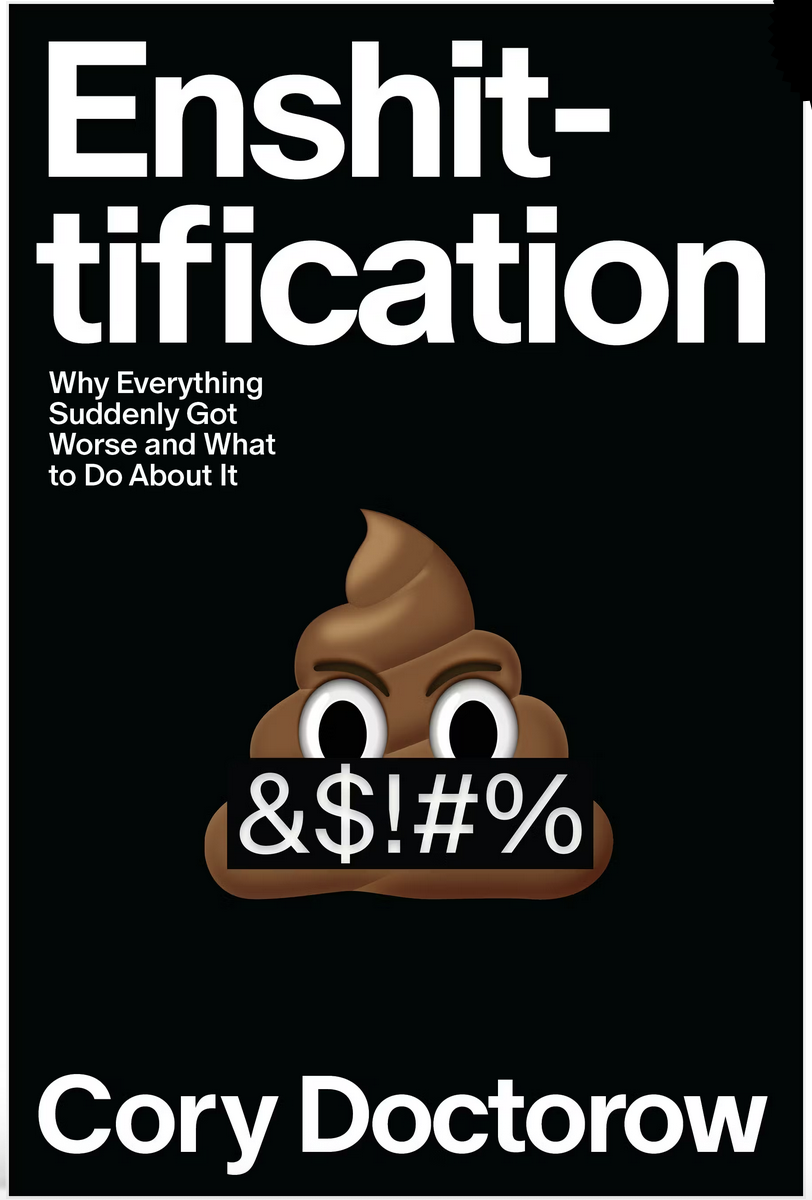
Enshittification: Why Everything Suddenly Got Worse and What to Do About It
Cory Doctorow, 2025
Macmillan
ISBN: 9780593653111
Review by Jacob Pleasants
Odds are good you have encountered Cory Doctorow’s idea of “enshittification” already. Enshittification was the American Dialect Society’s 2023 word of the year and has graced the pages of our website from time to time. But now we have it in book form!
If your podcast diet is anything like mine, you’ve been hearing a lot about this book over the last few weeks. For instance, here is Doctorow on…
Brian Merchant’s occasional podcast
Listen to any one of Doctorow’s podcast appearances and you’ll get a pretty nice encapsulation of his arguments. You’ll also get treated to what is always a rollicking conversation (I can attest that interviews with Doctorow are a pretty good time).
So, recognizing that I am contributing to what is potentially an already-saturated space, I am here to share my thoughts on this book. In particular, I’d like to explore what this book might offer to us in the world of education.
A Brief Summary
If you would like an in-depth summary of Doctorow’s arguments, his podcast interviews truly are the way to go. But for those who are newer to his ideas and want an even more tidy version, here’s what’s going on in this book.
The phenomenon of enshittification.
In its canonical form, this occurs on digital platforms, which bring together buyers/users and sellers/businesses. In the case of Google search, most of us are users and on the other end of the platform are businesses that are paying Google for ad placements. The platform stands in the middle, intermediating the two parties. Doctorow posits enshittification as the tendency for platforms to move through a series of phases.
At first, the platform is kind to its users. It provides a service (e.g., search) for free, and it tries to make its service as good as it can be. Once upon a time, Google was adamantly against the notion of selling ads on its search engine!
In a bid to extract value from those users, the platform will be kind to the business side of things. Google will provide companies the means to buy targeted advertisements. Things get worse for users, but the businesses are rather happy because the ads really do work.
In a bid to extract value from business, the platform will be made worse for businesses. The price to gain access to the users on the platform will be raised. The quality of the ad targeting will become worse. Cuts will be taken.
The platform is now pretty bad for all involved, and yet everyone is stuck in the shitty system.
Doctorow presents a series of case studies that illustrate this pattern. In addition to Google search, we have the Apple App Store, Facebook, Amazon’s marketplace, Twitter. A litany of digital services that were once quite useful, but now have become loathsome. So, why do we continue to use these enshittified platforms?
The causes of enshittification
To a degree, this is not a particularly surprising process. When you own a digital platform, there is going to be a capitalist impulse to squeeze as much value as you can from everyone involved with it, whether or not that makes your product shittier. But Doctorow’s central argument is that those impulses have historically been tempered by a collection of countervailing forces that make enshittification a rather bad business proposition. Your users could leave. Your workers could leave. A rival firm could make a not-shitty version of your platform.
The problem is that those countervailing forces have been badly weakened. Your users can leave, but you’ve made the switching cost so high that they probably won’t, even when they want to. Your workers could leave, but the labor market is pretty rough out there. Someone could make a rival product, but you’re good at squashing competition. Oh, and countries have kindly made it illegal to reverse-engineer your product. The coast, then, is clear for enshittification. And that’s exactly what we get.
The solutions
Enshittification has occurred because the bulwarks against it have fallen, but that isn’t inevitable. Those bulwarks could be brought back! Labor power could be restored through unions. Odious digital rights laws could be removed so that switching costs were eliminated. Regulators could break up monopolies so that alternatives could actually exist. These are not idle notions - Doctorow has very clear prescriptions of how we could make progress toward these goals.
Some General Thoughts
This book is an expansion of an essay, and as such it is not so much breaking new ground as it is elaborating upon an existing thesis. The book-from-an-essay always runs the risk of being little more than a longer version of the original. And so we need to ask: What do we get from the book version of “enshittification” that we didn’t from the original essay?
In terms of the main arguments, the answer to that question is “not all that much.” But I also don’t see that as a problem. In fact, if you look at the whole canon of Doctorow’s (prolific) writing, you can see a very consistent and overlapping intellectual project. Even the original “enshittification” essay wasn’t so much a radically new idea than a new term to describe phenomena that Doctorow had been writing about for years. You could therefore think of Enshittification (the book) as the “latest installment” in the larger canon. It can be a point of entry if you’re new to it. Or it can serve as an incremental expansion.
Even if you find the ideas familiar, the book is still just a lot of fun to read. What you get in the book form of the argument is a litany of wonderful examples and case studies. Countless examples of companies doing truly heinous things, enabled by absurd laws and regulations. Some are examples that have appeared in Doctorow’s other work, but there are new ones as well. And they are truly great, bringing what can at times be quite abstract and technical issues to concrete reality. Come for the thesis, stay for the case studies.
But enough of these general impressions. What wisdom does this book hold for the world of education?
Enshittification in Schools?
You won’t find many direct examination of education technologies in this book, and you won’t find any overt discussions of the context of schooling (one exception: he mentions the textbook as an example of something you used to be able to own and resell, but that has increasingly become “textbook as a service,” in turn eroding the secondary market and extracting ever more value from students). But Doctorow is adamant that his term ought to be adapted and used and applied and stretched as much as possible. So that’s exactly what I’m going to do.
Where might we find enshittification in our schools? Considering the causes that Doctorow identifies, we ought to look for digital platforms or services that, in one way or another, have locked in their users (be that students, teachers, administrators, whole organizations). We should look for ways that those platforms or services are uninhibited from steadily screwing over their users.
Learning Management Systems (Canvas, Google Classroom, etc.) are the obvious examples. If you’ve ever had the misfortune of being at a school that is trying to transition from one of these to another, you know just how high the switching costs are. And that’s at the organizational level. From a teacher or student perspective, you’re often mandated to use the platform whether you like it or not. It’s a ripe environment for enshittification, but has it happened? Have these platforms slowly gotten worse over time?
It’s actually a little hard to say. I haven’t seen too many obvious cases of, say, Instructure twiddling with the Canvas features or its fee structures to extract value from its users. But on the other hand, I am not privy to the enterprise purchasing agreements.
We definitely see plenty of that kind of fiddling for other edtech products, where the “freemium” model reigns. I recently had a conversation in one of my graduate courses on the slow paywalling of the features on the much-loved Kahoot! and we see the same thing happening on all of those AI platforms. Do you depend on Grammarly? Yeah, the free version doesn’t get you too far these days.
However, something like Kahoot! doesn’t have the kind of monopolistic power that lets it lock in users. If you’ve made a bunch of quizzes on the platform, it is definitely a cost to leave them behind. But there are lots of competitors out there and unlike switching off of something like Facebook, you don’t have to walk away from your whole social network, just those quizzes you made.
The lock-in for Learning Management Systems is, on the other hand, pretty significant. We ought to keep a close eye on those and any other digital systems that have so embedded themselves in our schools that walking away from them becomes painful. Any time a school becomes dependent on a technological system, the table is set for enshittification. All the more reason to avoid such entanglements in the first place.
Enshittification of schools?
Here I’d like to do something even a little more speculative. Could schools themselves be subject to enshittification?
In the case of public K-12 schools, the answer is clearly “no.” While some might lament the quality of the institution, schools do not “extract value” from students or even teachers. There are plenty of problems with the way our public schools operate, but enshittification is not really the right framework.
But maybe there are some schools that play the “value extraction” game. Consider those predatory for-profit postsecondary institutions. Or maybe even something like Alpha School in the K-12 space. These schools don’t exactly operate as “platforms” in the sense that they’re not quite operating a two-sided market between users and businesses. But it’s not too hard to imagine how a revenue-seeking school might lure students/parents in, only to slowly degrade the product while extracting tuition. There are certainly switching costs, especially in the higher education context where credits earned might not transfer to a new institution.
And yet, something doesn’t quite seem to fit. The bad actors in the school landscape strike me as more of a plain old-fashioned grift than an instance of enshittification. Most lacking, I would say, is phase one: many of those grifters were never good in the first place.
But maybe you think differently?