Civics of Technology Announcements
Book Clubs:
Technofeudalism: What Killed Capitalism by Yanis Varoufakis on this Thursday, October 22 at 8:00 PM EST. Read Kelsey Stoke’s recent blog post about the concept and register here.
Hyperscale: The Ambition and Excess of Big Tech’s Data Empires by Paris Marx on Tuesday, December 15 at 8:00 PM Eastern. Register here.
Note: This blog is cross-posted with permission from Punya’s blog.
By Punya Mishra
About a year ago my friend Bhawna Parmar published a piece in The Caravan called “Off the Books: Schoolgirls in Odisha tune into right-wing YouTube.” Bhawna spent months reporting in Khordha, a district in Odisha, my home state, and followed Roza, a fourteen-year-old who gets two hours a day on a phone. Roza’s school advertises the state’s “5T High School Transformation” program, with its smart classrooms and interactive whiteboards, while YouTube’s recommendation algorithm feeds her extremist political content, conspiracy theories, and revisionist history that tells her that her textbooks are lying. When I wrote about Bhawna’s piece at the time, I asked whether my own work on how teachers integrate technology, centered as it has been on the classroom, had missed the forest for the trees.
My colleagues Natalie Milman, Jason Trumble, Andrea Harkins-Brown and I have since taken that question further in an editorial for the Journal of Technology and Teacher Education, where we argue that educational technology research faces a crisis of legitimacy and that we, the practitioners of this research, earned a good part of it. We cite Roza’s story in the editorial because it exposes a mistake shared by two groups that usually see themselves on opposite sides of the technology in education spectrum. On one side are people pushing to ban phones and laptops from schools, and on the other are educational technology researchers who have spent decades studying technology inside classrooms. What both groups share is the idea that school is the only (or maybe the most important) place where children learn. As we write:
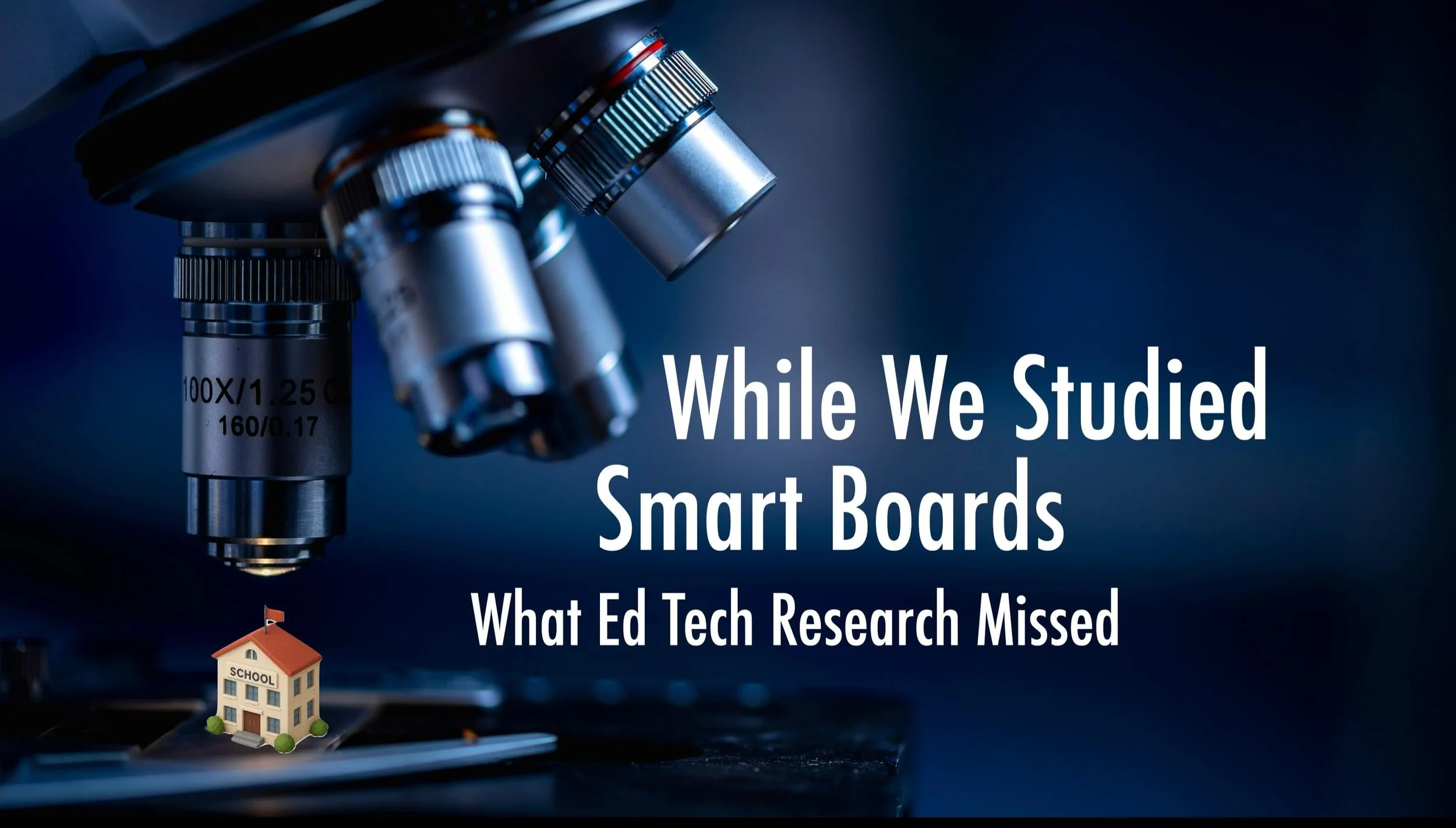
…those calling for bans on screens and those conducting research on educational technology share a foundational error: both assume the institution’s perimeter is where education happens. The ban does nothing about the algorithm that resumes its work the moment the student walks out the gate, nothing about the psychological transformation that has, for most students, already happened by the time they arrive in homeroom. Our research, for decades, studied what happened inside the walls while the most consequential education of our students’ lives took place outside them.
In truth, the most extensive uses of technology (for entertainment and learning) happen outside of schools. This has been true of television and social media, and it will be true of generative AI, with one significant difference. With earlier media, parents and teachers could at least see what children were getting access to, whether television programming, YouTube or social media channels. Generative AI, a technology engineered to converse, flatter, and ingratiate, will do most of its work in private one-on-one conversations that others cannot easily see.
This misperception of schools or classrooms as being the true sites of learning is reflected in the theoretical frameworks that our field has developed over the years. This is not to deny the value of these frameworks (whether TPACK, which Matt Koehler and I co-developed, SAMR, or PIC-RAT), but it is also important to acknowledge that they all share the same blind spot, namely that all of them focus on teachers in classrooms and, in the process, assume that classrooms are where learning (at least learning that matters) happens. That is why, as we point out in the editorial, Roza’s story came to us from a journalist rather than from an educational researcher.
Marshall McLuhan, Walter Ong, and Neil Postman understood that media reshape the environments in which people think, and Safiya Noble, Ruha Benjamin, and Virginia Eubanks documented how algorithms harm the people they sort, students included, yet our field rarely engaged with any of them in any substantive way. McLuhan, Ong and Postman would, in fact, struggle to get published in most traditional ed-tech journals. Even Audrey Watters, who spent years documenting ed tech’s history and its recurring hype, has been cited only selectively.
What we did instead was ask comparative questions, this medium versus that, and the answers we got tell us more about the instrument than about the technologies. In 2025 Melumad and Yun ran four experiments with more than 4,500 people and found that those who learned about a topic with ChatGPT came away with shallower knowledge than those who used a Google search, and the advice they later wrote for others was sparser and less original. Go back a few years, though, and Google was the problem. Fisher and colleagues found that people who searched the internet to prepare for a quiz did worse than people simply handed the same information, even though the searchers felt more confident about what they knew. A decade before that, Sparrow and colleagues reported in Science that people who expect information to be available online remember where to find it rather than the information itself, a change in memory they presented as cause for concern. Print beat the web, the web beat AI, and in about fifteen years Google went from cognitive threat to gold standard.
In an earlier post I suggested a few reasons for this pattern. The technologies we grew up with feel like real thinking while new ones feel like cheating. We have also had years to get good at searching, while most of us are still novices with chatbots, and these studies tend to define learning as remembering trivia, when knowing where to find something can be an intelligent adaptation. Every one of these shifts involves tradeoffs, and the useful question is which tradeoffs, and for whom. None of these studies could have told us anything about Roza, which is the editorial’s point: the comparative frame, and the question behind it, may have been broken from the start.
At the same time, the impact of these technologies on teenage minds and on the broader social and political discourse is becoming impossible to ignore, and the backlash has arrived. Sweden is spending tens of millions of euros to undo fifteen years of laptops in its classrooms, thirty-five US states banned cellphones in K–12 classrooms in a single year, and Eric Schmidt was booed at the University of Arizona’s commencement this spring for telling graduates they would help shape AI. It is tempting to file all of this under moral panic, alongside Socrates worrying about writing and the alarm over novels, comic books, and video games, but I don’t think that fits when the companies involved are among the most valuable in history and their business models depend on capturing the attention of the children we teach. Given this, the editorial is blunt about where the responsibility lies:
What is sad is that if any field should have seen what was coming, it was ours: the attention economy, the polarization, the rewiring of a generation’s relationship to truth. While the platforms were doing it, we were, for the most part, running careful studies on whether interactive whiteboards improved test scores on the fractions unit, investigating teachers’ beliefs/perceptions about educational technology, researching short-term uses of technology and its short-term effects, or conducting small-scale studies with little if any long-term impact. That is on us. Not on the companies, whose incentives were exactly what we should have expected. Not on the legislators reaching for the blunt instrument of the ban, but on us.
This is not to deny the field its real successes, from fan fiction communities to assistive devices that give a child a voice, but each of these successes is tied to a particular child, teacher, and community, and our research culture has never known how to defend the particular. Aristotle set phronesis, the practical wisdom of knowing what to do here, with these people, now, apart from episteme, general knowledge, and techne, craft. Teaching depends on phronesis, yet our field invested almost entirely in techne and episteme. Generative AI, which we call the “apotheosis of techne,” will complicate matters even further, since a tool built to give the same fluent answer to everyone pulls us toward the general, when a good teacher’s honest answer to most questions about technology is that it depends on the child, the subject, and the moment. As we put it, “Knowing that ‘it depends’ is the finding, not a confession of defeat.”
In the editorial we ask for rigor that fits a moving, ecological, particular object, for researchers willing to enter public fights over AI vendor claims, surveillance dashboards, and mandates that treat teachers as “implementation surfaces,” and for changes to the methods courses, dissertation standards, and promotion criteria that shape a field’s habits.
There is a lot more in the editorial, which I hope you will read in full. We must add that we are being deliberately provocative, and my co-authors and I would rather be usefully wrong, corrected by colleagues who care about teachers and about this field, than safely silent. We would love to hear what you think.
This piece draws on the first of four editorials on the grand challenges facing technology and teacher education, a series that will end in a call for a JTATE special issue. The second, “The Crisis We Cultivated,” led by Natalie Milman, is now out. It argues that the field keeps its crisis going by forgetting its own history, treating each new technology as unprecedented and rediscovering lessons from the Apple Classrooms of Tomorrow project and the Office of Technology Assessment reports of the 1980s and 1990s, and it names research the field could stop doing, from media comparison studies to yet another study of teacher self-efficacy. Links to both are given below
Mishra, P., Milman, N. B., Trumble, J., & Harkins-Brown, A. R. (2026). Editorial: The crisis we earned: Educational technology research and teacher education. Journal of Technology and Teacher Education, 34(2), 141–153. https://doi.org/10.70725/204083qohprp
Milman, N. B., Trumble, J., Harkins-Brown, A. R., & Mishra, P. (2026). The crisis we cultivated: Educational technology research and teacher education. Journal of Technology and Teacher Education, 34(3), 253–266. https://doi.org/10.70725/286027emsral