Civics of Technology Announcements
Conference This Week! Starting Wednesday, you will need a password to access our conference page, which will have Zoom links to the sessions. If you’re registered, we will send you the password via email. If you haven’t done so yet, register now!
September Book Club: We will be reading the new book, “Coding Kids: Big Tech's Battle to Remake Public Schools” by our conference keynote speaker Natasha Singer on September 29th at 8:00 PM EST. Register here and pre-order the book here so you have it when it releases on September 8th! We will discuss the book for 45 minutes and then be joined by Natasha for a 30-minute Q&A.
October Book Club: On Thursday, October 22 at 8:00 PM Eastern, we’ll be discussing Technofeudalism: What Killed Capitalism by Yanis Varoufakis. Register here.
From the Library of Babel Group: On Tuesday, August 18 at 9AM PT, the Library of Babel Group's AI Resisters series hosts Common Knowledge of the Second Kind, a Conversation with Dave Bella, exploring his and Jonathan King's 1989 thought experiment on how supercomputers might reshape trustworthy knowledge in education, now our reality. Facilitated by Tim Reierson. Read the paper in advance and bring questions. Register here.
Author Bio
Kelsey Stokes finished her Ph.D. at Baylor University in Texas and is beginning her career in academia as an Assistant Professor at SUNY Oneonta. She writes and researches primarily about decolonization in the humanities, digital colonization, and some critical media literacy. When she isn't working, she loves a good video game, a Romantasy novel, or snuggling up to her fiancé and three dogs.
“I don’t use any of that stuff,” one of my participants, we will call her Renee, said of the classroom apps and district-purchased platforms. “I’m really concerned about like, data mining because there aren’t really any ‘rules’ against it. Companies can get away with just about anything if they claim it’s for ‘educational purposes.’ The only app I use is maybe YouTube if I want to show a video or something.”
In the past year or two, I have become increasingly interested in technological platforms, AI, and other EdTech in both higher education and in K-12 and how teachers use them. My interest in the topic came out of my dissertation research, which was admittedly around an entirely different subject. I primarily study decolonizing curriculum, but this line of thinking has also led me to consider digital colonization and how corporations use technology to influence individuals, institutions, and entire countries. So, during my dissertation study, I encountered the overwhelming frustrations and fears my teachers wrestled with when it came to integrating technology in their classrooms. This experience led me to look more deeply into popular Social Studies and Language Arts classroom apps and platforms, how the data on those apps are used, and whether teachers were aware of the broader socio-political and technical realities of their EdTech.
I worked with five K-12 teachers during my dissertation research, two in Social Studies, and three in Reading Language Arts, who expressed immense concern and skepticism around the ever-growing pressure to integrate more and more apps and technological tools in their teaching practices. The teachers cited the usual suspects in their concerns, such as AI and academic integrity, but they also discussed other issues such as forced integration of applications like IXL in remediation programs, data mining, and security breaches that compromised students’ and teachers’ information. Through discussing and working with these teachers, I came to consider what they were experiencing and critiquing as Technofeudalism and its encroachment in education.
In this post, I’ll discuss: What is Technofeudalism? How does it manifest in education? And what are our options as educators? And, if you’re interested in learning more and pondering these questions with me, please read Technofeudalism by Yanis Varoufakis and join me for a Civics of Tech book club in October!
What is Technofeudalism?
Technofeudalism is a term coined by Yanis Varoufakis (2024) to describe a new form of late-stage capitalism in which our economy has become totally enmeshed with our digital systems. In this economy, we—the average users and consumers—become like digital “serfs” laboring for Tech Giants, who represent the feudal overlords. Every click, every bit of engagement on social media, and every outright purchase helps generate profits for Tech Elites who own these platforms. This also means that there is more incentive for the owners of these apps, especially social media apps, to keep the user connected and addicted. Subsequently, content like “rage-bait” or other forms of click baiting is encouraged as it drives engagement and keeps users reading, commenting, sharing, and responding.
The insidious part of Technofeudalism is that it often seems invisible or intangible since it exists in the digital realm, and since users may not be actively purchasing products on applications, it may be unclear how their engagement is driving profits for platform owners. Additionally, with the rise of “influencer” culture online or other methods of content creation, there is some revenue or income for individuals posting across platforms, which may feel fair or like willing participation in a free market. However, again, the owners of these applications also generate profit from the advertisements, engagement, and user-base, so the Tech Giants ultimately benefit from the creativity and efforts of the individuals creating content or exploring on their sites all while doing little to contribute to that labor. In short, Technofeudalism ensures a few wealthy elites benefit from the labor and interactions of the user base, often without the knowledge or, importantly, the consent of those users.
What does this have to do with education?
Technofeudalism shows up in education, too, and many teachers are keenly aware of this reality even if they do not have the language to name it. One of the most obvious ways we see Technofeudalism in the classroom is through corporate influence in education through curricular materials and platforms. For example, SpringBoard is a curricular package that College Board sells to districts with the promise of raising student test scores and increasing college readiness. SpringBoard curriculum includes paper materials, activities, and suggested texts, but it also includes classroom apps and skills-based assessments through those platforms.
In a way, this is not new in education for companies to sell their materials and promises for academic improvement to school districts, but the addition of educational apps creates a new two-way interface between the classroom and the company. Previously, if a teacher was uninterested in a class textbook and they did not engage with it, the company had no way of knowing. Now, companies have the ability to see who is using which applications and how students are performing because there are little to no legal protections on data mining if companies say they are using the data for “educational purposes” (Skowronski, 2022). Therefore, companies can have continual access to student data and progress, but, as many teachers I worked with pointed out, there is little incentive for these corporations to say students have progressed significantly. This would make their curriculum obsolete and would effectively end their access to profits and growth. Some of the teachers I worked with felt skeptical and that these programs would provide accurate depictions of student growth in order to continually identify “gaps” and needs for improvement that corporations could then address with more materials or continued use. It becomes a mutually reinforcing system.
So, what are our options as educators?
This one is tricky because there is no one option or easy solution to this multi-layered problem. For the purpose of this post, I will discuss a few options that came up in some of my more recent research and work with educators, but I acknowledge that these options are not one-size-fits-all solutions, nor do they address every nuance or scenario in education. The first solution is one that is maybe a more obvious one, and it is one that has been backed by many media literacy researchers and educators (Nichols & LeBlanc, 2021), and that is that there is a need for a more comprehensive approach to digital and media literacy both in teacher preparation programs and in K-12 education. Much of media literacy is often boiled down to “fact-checking” sources which, while important, over-simplifies the complex capitalistic and material consequences of technological usage. Instead, teacher preparation programs and classroom teachers should discuss what Civics of Tech board member, Phil Nichols and his colleague Antero Garcia call (2022) broader platform ecologies, shown here in the figure below.
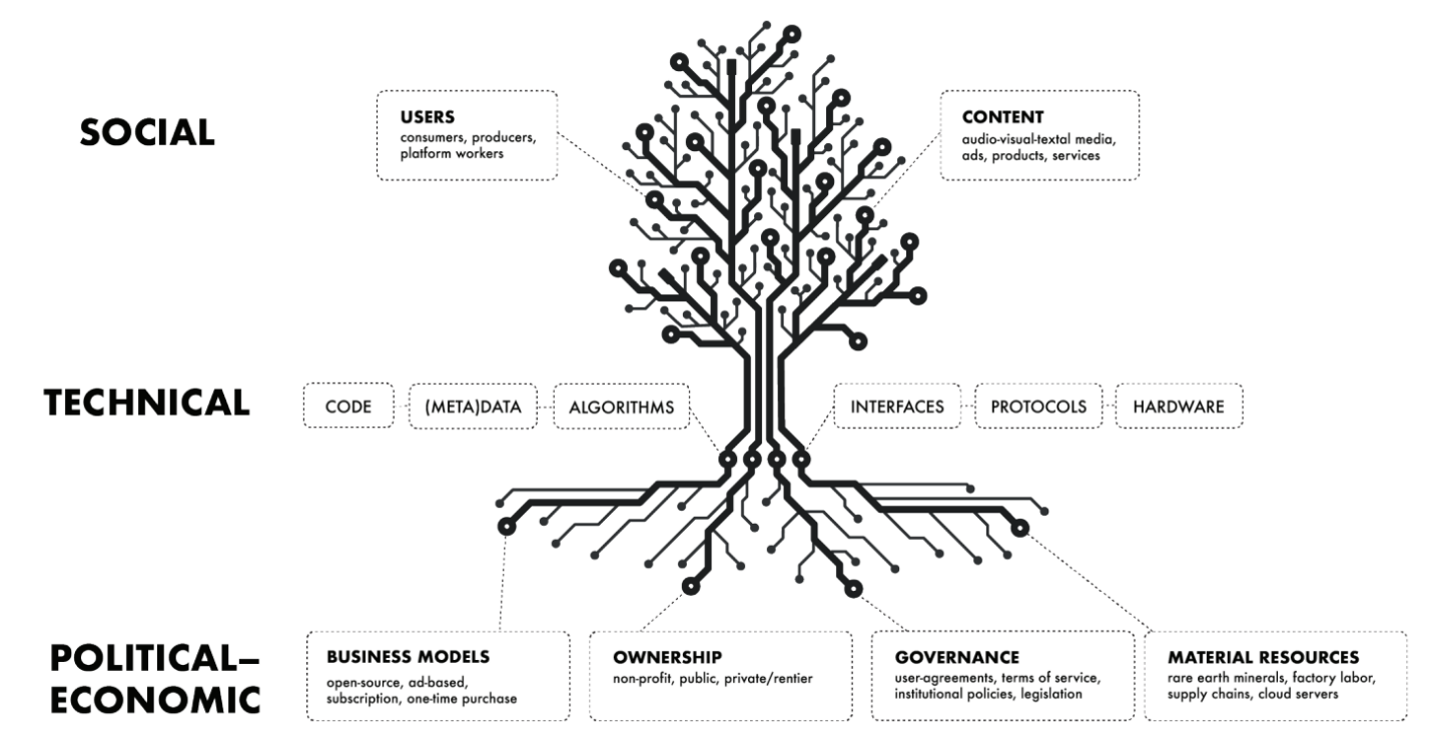
Image from “Platform Studies in Education” by Nichols & Garcia, 2022, Harvard Educational Review
The increasing number of technological interfaces in education, AI, and platforms outside of schooling all call for their own “literacies” in which we deeply examine the social, technical, and broader political-economic relationships and implications. We need to have these deeper, more nuanced discussions around technology and EdTech apps in our teacher preparation programs and in our K-12 spaces. That leads me to the second point, which is resources and policy changes for educators and students.
Many of the teachers in my dissertation study expressed that they were well aware of some of the problems with the school platforms, but they were required to use those platforms by their schools or states. For example, in Texas, IXL is required in many districts for remediation programs for students, whether or not the teachers believed the program is effective for student learning. IXL also had a data breach (“IXL Data Privacy Litigation,” 2025) where student information was compromised, so many teachers expressed concern over the legitimacy and safety of the program. This and other similar issues demonstrate the need for more stringent student privacy and protection policies and more autonomy and ethical alternatives for teachers. This could look like pushing for updating national policies such as COPPA and KOSA and advocating for more policies that keep companies from leveraging political influence to get their materials into classrooms.
Until some of these solutions come to fruition, many teachers are choosing to practice what I call technological aliteracy. Unlike illiteracy, where an individual may be unaware of or unable to work a new platform, aliteracy suggests that educators are aware of new technologies and have the ability to learn, but they choose not to. This does not also mean that these teachers are against technology in all its forms, but rather that they choose skepticism or to not engage with some platforms until their students’ privacies are protected or until they understand the ways that the data and funds will be used. There is an opportunity here to create some easily accessible resources such as a list of educational platforms and their owners, privacy policies, and known material or technical resources. Additionally, such a list could perhaps provide some information for companies and apps that practice more equitable alternatives and are accessible to teachers.
In the meantime, the best thing we can do as individuals on a personal level is limit our scrolling and interactions online—especially when it comes to emotionally and politically charged clickbait or comments—and deeply investigate the apps we use on a personal level and an educational level. Since we are so intertwined with technology in the classroom, it is impossible to say we can stop using required applications, Learning Management Systems, or monitor student devices, but we can begin to question who benefits most from our engagement with these systems and who is potentially harmed by them. And, when possible, if there is a way to choose materials that do not directly or indirectly fund Tech Giants, we can advocate for more widespread adoption of those educational tools.
References
IXL Data Privacy Litigation. (2025). EdTech Law Center. https://edtech.law/cases/nonconsensual-student-data-mining-powerschool-and-ixl-learning/
Nichols, P., & Garcia, A. (2022). Platform Studies in Education. Harvard Educational Review, 92(2).
Nichols, P., & LeBlanc, R. J. (2021). Media education and the limits of “literacy.” Curriculum Inquiry. https://drive.google.com/file/d/19oL0IXhUmt5xwFLTk1sTILGgXk-oRaWu/view?usp=drive_open&edoph=true&usp=embed_facebook
Skowronski, D. S. (2022). COPPA and Educational Technologies: The Need for Additional Online Privacy Protections for Students. Georgia State University Law Review, 38.