It's More Than a Human-in-the-Loop (HITL): Rethinking Educators' Roles When Teaching With and About GenAI
Civics of Technology Announcements
Annual Conference: We are holding our 5th Annual Conference on August 6th-7th, 2026! The full program is now viewable on our conference page. Our keynotes this year are Dr. Meredith Broussard (data journalist & author of More than a Glitch among other books) and Natasha Singer (NYT edtech reporter & author of the forthcoming book, "Coding Kids: Big Tech's Battle to Remake Public Schools”). You can register here.
Next Book Club: We will be reading the new book, “Coding Kids: Big Tech's Battle to Remake Public Schools” by our conference keynote speaker Natasha Singer on September 29th at 8:00 PM EST. Register here and pre-order the book here so you have it when it releases on September 8th! We will discuss the book for 45 minutes and then be joined by Natasha for a 30-minute Q&A.
New Partner Organization: We are happy to announce that the Young Data Scientists League (YDSL) is our newest partner. YDSL is a 501(c)(3) non-profit provider of culturally relevant data science and AI ethics research experiences aligned to K-12. Their mission is to provide every student with the pathways and motivation to use critical research and storytelling skills to shape our world in diverse, creative, and justice-centered ways. As a partner organization, YDSL will be invited to provide updates to our community through board meetings and announcements. You can learn more at https://www.youngdatascientists.org/. You can find all partner organizations on our About Us page.
From the Library of Babel Group: On Tuesday, August 18 at 9AM PT, the Library of Babel Group's AI Resisters series hosts Common Knowledge of the Second Kind, a Conversation with Dave Bella, exploring his and Jonathan King's 1989 thought experiment on how supercomputers might reshape trustworthy knowledge in education, now our reality. Facilitated by Tim Reierson. Read the paper in advance and bring questions. Register here.
By Natalie B. Milman
The rapid adoption of generative artificial intelligence (GenAI) in education has raised complex and often polarizing concerns regarding ethics, transparency, bias, privacy, and academic integrity, all of which are topics many other Civics of Technology blog authors have emphasized, as well. It has also prompted important questions about the evolving role of educators in teaching with and about GenAI, including how they design assessments, oversee GenAI-assisted learning, and exercise human judgment when GenAI informs educational decisions. Several international governance frameworks such as the European Union's (2024) AI Act, the United Nations Educational, Scientific and Cultural Organization’s (UNESCO) Guidance for Generative AI in Education and Research (Miao & Holmes, 2023), and the Organisation for Economic Co-operation and Development (OECD) AI Principles, provide guidance by emphasizing that humans must remain meaningfully involved in AI-supported decision-making through oversight, professional judgment, accountability, and the ability to intervene when necessary. This oversight is commonly reflected in concepts such as human-in-the-loop (HITL) and human-on-the-loop (HOTL), which describe complementary approaches to ensuring that AI systems support, rather than replace, human expertise in educational contexts.
In human–computer interaction and AI governance, human oversight is most commonly conceptualized through human-in-the-loop (HITL) and human-on-the-loop (HOTL) models. In HITL frameworks, humans actively participate in the decision-making process by reviewing, validating, or approving AI-generated outputs before they are implemented. In contrast, HOTL frameworks allow AI systems to operate with greater autonomy while humans monitor system performance and retain the authority to intervene, modify, or override decisions when necessary. More recently, however, Lazaros et al. (2026) expanded this framework by identifying several additional "loop configurations" (p. 9) within the broader HITL taxonomy. The configurations, illustrated in Figures 1 and 2, provide a more nuanced framework for conceptualizing the diverse ways humans may interact with and oversee GenAI systems. These expanded loop configurations better capture the range of oversight practices humans may engage in when working with GenAI systems. Given the generative nature of these technologies and the potential scale, variability, and complexity of their outputs, human oversight extends beyond reviewing or approving individual GenAI-generated decisions.
Collectively, these loop configurations more accurately reflect the complexity and evolving nature of GenAI uses in education, where educators may assume different forms of oversight, engagement, and responsibility across the teaching and learning process.
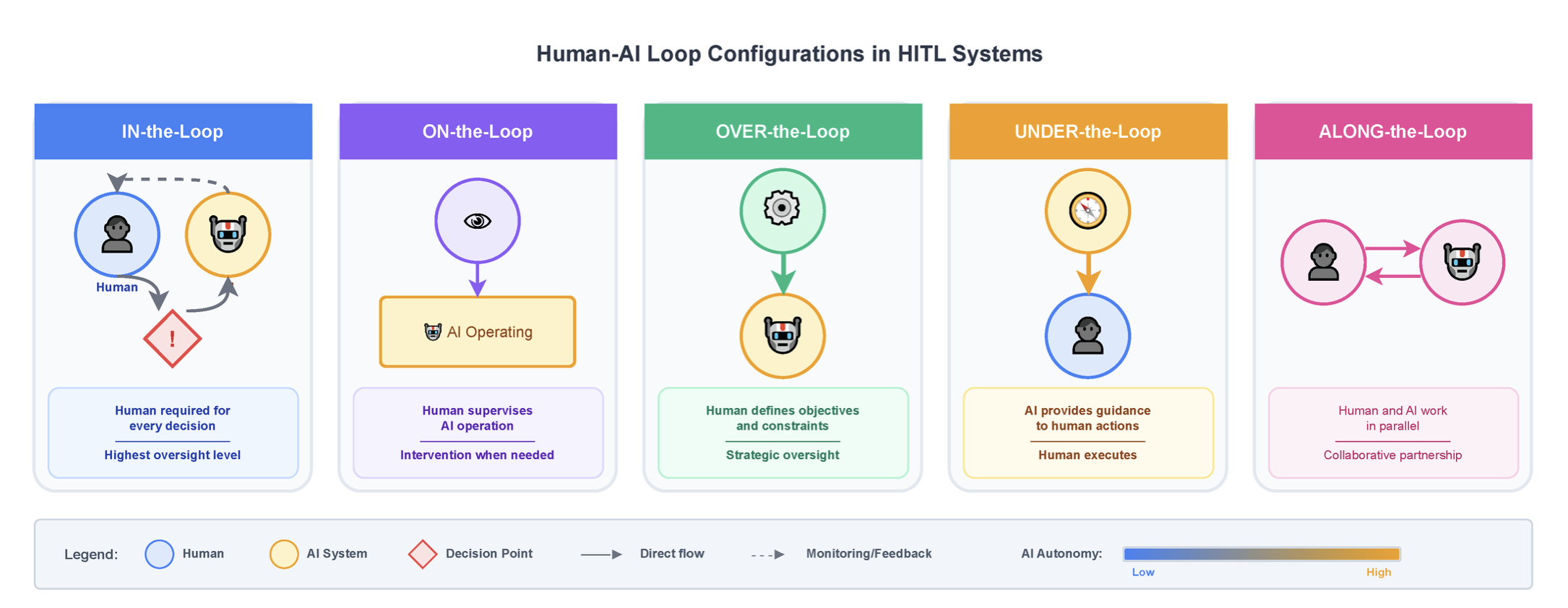
Figure 1 Human-AI Loop Configurations in HITL Systems (Lazaros et al., 2026, p. 10)
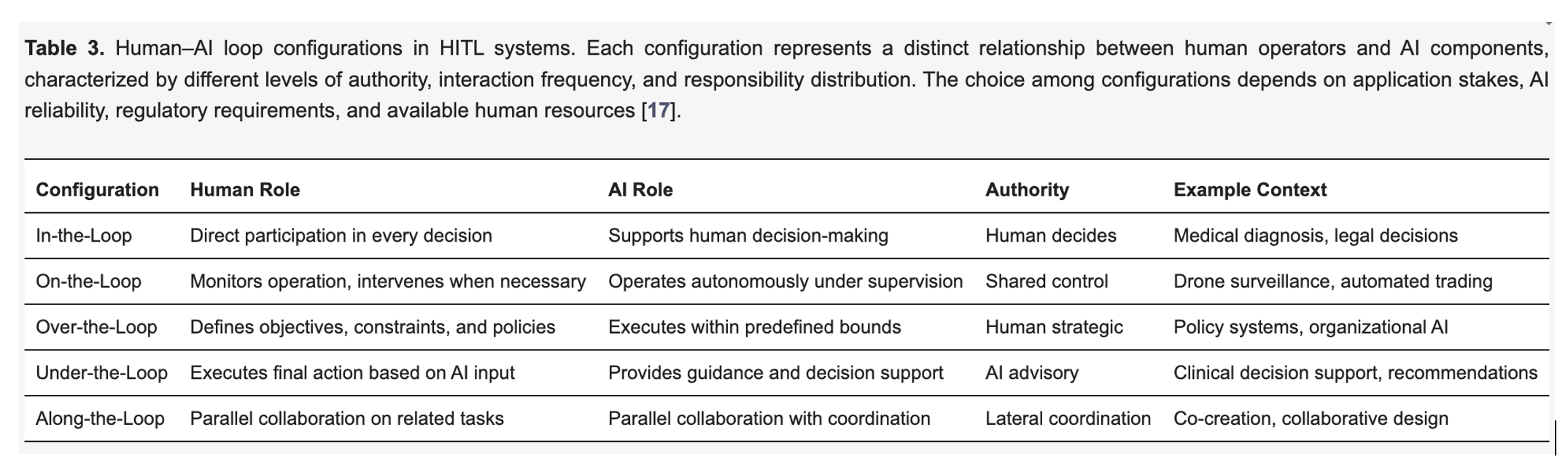
Figure 2 Human-AI Loop Configurations in HITL Systems (Lazaros et al., 2026, p. 9)
Although the HITL taxonomy provides a useful framework for understanding models of human oversight, it lacks guidance about how educators might enact these roles in practice and in real contexts. Rather than functioning as a foolproof safeguard, Crootof et al. (2023) noted that human oversight introduces its own set of vulnerabilities, such as gaps in user expertise, flawed human-computer interfaces, and misaligned task handoffs that can lead to system failures. Drawing on recommendations for policymakers and the legal community, Crootof et al. (2023) emphasized that it is essential to define why human oversight is necessary, clearly outline the specific responsibilities involved, and consider the context (e.g., culture, environment, and resources). These considerations are particularly critical in educational settings, where educators' duties extend beyond monitoring GenAI systems to include complex pedagogical, ethical, and professional decision-making.
As educators are increasingly called upon to serve as both content experts and the human safeguard for GenAI in the teaching–learning process, understanding their role within HITL frameworks becomes essential. Yet, simply positioning a HITL does not guarantee sound outcomes. As Crootof et al. (2023) cautioned,
“…merely inserting a human in the loop does not necessarily result in the best of both human and machine. Instead, adding or maintaining a human in the loop of an automated system creates a new entity: a hybrid system…Getting humans to work well with algorithmic systems is far more difficult than it may first appear." (p. 461)
It is also important to understand that educators are not just a separate part of this oversight system, but instead, they become part of a complex (and sometimes messy) hybrid system whose effectiveness cannot be assumed. Exploring these loop configurations now, even as they evolve alongside GenAI and other technologies, in addition to our interactions with them, enables educators to move beyond simply being placed “in the loop” toward intentionally shaping how their judgment, pedagogical expertise, and GenAI capabilities are integrated to support ethical and meaningful teaching and learning.
References
Crootof, R., Kaminski, M. E., & Price II, W. N. (2023). Humans in the loop.Vanderbilt Law Review, 76(2), 429–511. https://scholarship.law.vanderbilt.edu/vlr/vol76/iss2/2/
European Union. (2024). Regulation (EU) 2024/1689 of the European Parliament and of the Council of 13 June 2024 laying down harmonised rules on artificial intelligence (Artificial Intelligence Act) and amending Regulations (EC) No 300/2008, (EU) No 167/2013, (EU) No 168/2013, (EU) 2018/858, (EU) 2018/1139 and (EU) 2019/2144 and Directives 2014/90/EU, (EU) 2016/797 and (EU) 2020/1828 (Artificial Intelligence Act). Official Journal of the European Union, L, 2024/1689. https://eur-lex.europa.eu/eli/reg/2024/1689/oj
Lazaros, K., Vrahatis, A., & Kotsiantis, S. (2026). Human-in-the-loop artificial intelligence: A systematic review of concepts, methods, and applications. Entropy, 28, 377-428.https://doi.org/10.3390/e28040377
Miao, F., & Holmes, W. (2023). Guidance for generative AI in education and research. UNESCO. https://unesdoc.unesco.org/ark:/48223/pf0000386693
Organisation for Economic Co-operation and Development. (2024). OECD AI Principles. OECD. https://oecd.ai/en/ai-principles
United Nations Educational, Scientific and Cultural Organization. (2024, May 3). OECD AI principles overview. UNESCO. https://unesdoc.unesco.org/ark:/48223/pf0000381137