Civics of Technology Announcements
Book Club this week: Techno-Negative: A Long History of Refusing the Machine by Thomas Dekeyser. Join us on Wednesday, June 24th at 7:00 PM Eastern Time. Register here.
Annual Conference: We are holding our 5th Annual Conference on August 6th-7th, 2026! Our keynotes this year are Dr. Meredith Broussard (data journalist & author of More than a Glitch among other books) and Natasha Singer (NYT edtech reporter & author of the forthcoming book, "Coding Kids: Big Tech's Battle to Remake Public Schools”). Learn more here and register here,. Proposal decisions are coming soon for those who submitted.
News from our Partner Organizations:
Library of Babel: On October 6-7, 2026, The Privacy Center at Georgetown Law will host Life After Data: the Conference on De-datafication. The event will bring together researchers, activists, writers, artists, students, and technologists for a conversation around the following prompt: Imagine a future in which digital data is no longer the currency mediating all of our social, economic and political systems, structures and practices. How might we get there from here? The program will consist of a combination of shorter lightning talks and longer papers by invited speakers, interspersed with workshop sessions during which all participants will discuss the conference presentations. Travel and accommodation costs for invited speakers will be covered by the Privacy Center. Details available on the website. Submit your proposal by June 30! See flyer here.
Dr. Heidi Reed is an assistant professor in the Organization Studies & Ethics department at Audencia Business School in Nantes France and researches the relationship of business in society. heidi.reed@audencia.com.
Three years ago, I somewhat reluctantly accepted to create a course called “Responsible AI and Ethics.” Though I teach business ethics, I didn’t feel particularly qualified to teach about AI. Yet, like many of us, I stepped in because the demand for “real” AI experts far exceeds the supply. Thinking about how to structure the course, and with a lot of help from the Civics of Technology curriculum page, I humbly began with a simple yet terribly complicated question, what is AI?
And of course, I was hooked as I fell into the research rabbit hole of AI definitions. As wonderfully explained by Punya Mishra, the term originated as a kind of counter to cybernetics and involved some scholarly drama. Over time, Alberto Romele argues that “AI" has become a floating signifier and highlights that discussions on the ethics of AI should involve how we communicate about it. And of course, Emily Tucker and the Center on Privacy and Technology have powerfully committed to stop using the term, providing instead some guidelines for how to talk about this technology by describing what it does and naming the companies and human decisions behind it.
Well, it would have taken a lot to turn all that information into a lecture so I did what I normally do when I need to be efficient and optimize lesson planning time: I outsourced the labor to my students and called it an in-class activity!
Lesson Plan Part 1: What is AI?
Working in small groups, ask students to provide the class with three AI definitions either using a whiteboard or a digital collaborative space so everyone can see each group’s work. Each group should share:
1) A technical definition from an authoritative institutional source, Civic Online Reasoning has great teaching resources on assessing source quality that you can do beforehand,
2) A provocative definition from any source other than Generative AI, and
3) A group definition where they work together to create their own with no rules attached.
Once all the definitions are posted, ask students what they notice and then ask why different people or organizations might define AI differently. I’ve listed below two of the most common institutional definitions my student groups find to give you an idea of how discussions might go!
· IBM: “AI is technology that enables computers and machines to simulate human learning, comprehension, problem solving, decision making, creativity and autonomy”
· EU AI Act: “‘AI system’ means a machine-based system that is designed to operate with varying levels of autonomy and that may exhibit adaptiveness after deployment, and that, for explicit or implicit objectives, infers, from the input it receives, how to generate outputs such as predictions, content, recommendations, or decisions that can influence physical or virtual environments”
Not exactly the same framing, right?
As for provocative definitions, many groups find more philosophically elegant citations, but this one has been my favorite so far: a Scooby Doo Mask Reveal Reddit meme where AI is exposed as if/then/else coding.
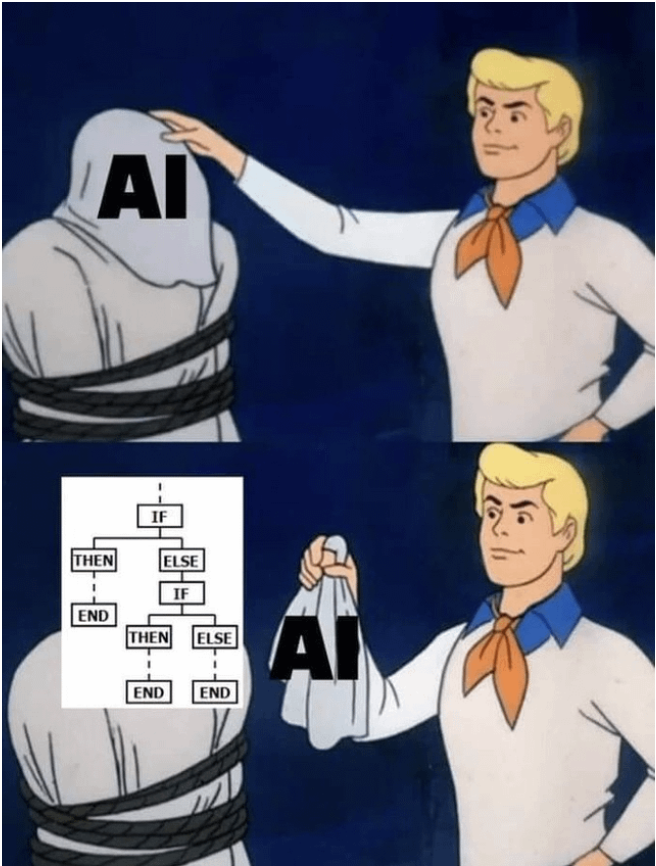
For a group definition created by students, “mimic monster” was one that I felt managed to be highly accurate while being exceptionally concise.
Whether thought provoking or attempting to be technical, none of them really fully capture what AI actually is though. After seeing a LinkedIn post by a friend and fellow academic, Solène Juteau, sharing how she used printed images in class to learn about digital infrastructure and innovation, I had an idea. What if instead of asking what is AI, we asked what is AI made of?
I began to collect images of the many things needed to “make” AI: screenshots of artist Karla Ortiz’s website where she sells her work, Python code to scrape pictures of artwork like hers for training data, and under waged sweat shop data labelers sitting in a dark room providing context to training sets before machine learning can occur. By the way, Ortiz’s powerful speech to the US. Senate Judiciary Subcommittee on Intellectual Property is worth a read as is watching the BBC interview with data labeler Mophat who said this work made him feel like his “entire life has ended.”
Another set of images includes fluorite (a component of PFAS or forever chemicals), silicon wafers, a microchip clean room, and a screen shot of the US CHIPS and Science Act whose goal is to reshore toxic semiconductor manufacturing as part of a techno-nationalist agenda, framed as digital sovereignty, in the race to AI. On that note, Chris Miller’s video of How an AI chip war could destroy the global economy provides an excellent overview of the current geopolitical issues with semiconductor manufacturing (spoiler alert, Taiwan produces 90% of the world’s chips). The video pairs nicely with Lisa Nakamura’s Indigenous Circuits: Navajo Women and the Racialization of Early Electronic Manufacture.
In all, I made a deck of 30 images which you can download from the curriculum page and of course expand on!
Lesson Plan Part 2: What is AI made of?
Introduce the activity by explaining that changing the way we ask questions about technology helps us to have deeper and more critical reflections about it. Even slightly shifting the wording of a question can have radical impacts on the answer.
Option 1: Small Groups
Print out the images for each group. Provide markers and a large paper roll or sticky notes. Alternatively, if you have enough whiteboard space you could use magnets to hold the images. Ask learners: What are these images of? Which seem to fit together? Arrange the images into a relational map creating categories and/or using arrows to show how they are connected.
Option 2: As a Class
Print and pass out the images to learners. Depending on class size, you may give each learner 1 image, selecting in advance which to use and which to leave out, or you might pass out all images. In this case, some students might have 1, others 2, etc. When I tried it this way, surprisingly no one seemed confused or bothered that the amount of images per student was not the same. Ask learners: What is your image of? If you don’t know, walk around and see if others can help you. How does your image relate to or connect with others? Try to form groups of 3-5 images that seem to go together best. If you have more than 1 image, you can exchange as needed to form groups that make sense.
I have used both in the classroom and personally prefer Option 2 as it’s unusual for us to do an activity as an entire class while we constantly have small group work. Discussion questions for after can include:
• How does shifting the question from what is AI to what is AI made of change the way we think about AI?
• What other questions could we ask? If they don’t come up with these questions on their own, suggest, what is the cost of AI and who “pays” this cost?
Part 2 can also be done without having done part 1 of course. As follow up activities you can have them explore Kate Crawford and Vladan Joler’s website Anatomy of an AI System, think of and find additional images, or for a longer activity, have them come up with facts or statistics related to each image. Students won’t be able to figure out all of the images so you will need to help them. When they worked together as a class, I was surprised that they almost got all of them, but they kept thinking the pile of drying lithium was snow and couldn’t get unstuck.
What I like about this activity is that it challenges representations of AI as a magical sparkle ✨or a servile robot 🤖. It helps demystify AI as a sociomaterial construction of natural resources, human labor, habitats of non-human animals, government legislation, toxic chemicals, computer codes, and techno-capitalist ideologies, just to name a few. Asking what is AI made of highlights its social and environmental impact, helping us to better reflect on the broader critical questions of who is helped by technology and who is harmed.
*I did NOT use GenerativeAI to think of or write this blog.
**The activity What is AI made of? is part of a larger research project on using unplugged learning for AI ethics funded by the Audencia Foundation.