The Future of Creative Workshops is Brighter than Ever!Announcing the Next Steps in the Click Here if You Agree Project
Civics of Technology Announcements
Annual Conference: We are holding our 5th Annual Conference on August 6th-7th, 2026! Our keynotes this year are Dr. Meredith Broussard (data journalist & author of More than a Glitch among other books) and Natasha Singer (NYT edtech reporter & author of the forthcoming book, "Coding Kids: Big Tech's Battle to Remake Public Schools”). Learn more here, register here, and submit proposals here ← Last week to get your proposal in!
Book Club in June: Techno-Negative: A Long History of Refusing the Machine by Thomas Dekeyser. Join us on Wednesday, June 24th at 7:00 PM Eastern Time. Register here.
News from our Partner Organizations:
Library of Babel: On October 6-7, 2026, The Privacy Center at Georgetown Law will host Life After Data: the Conference on De-datafication. The event will bring together researchers, activists, writers, artists, students, and technologists for a conversation around the following prompt: Imagine a future in which digital data is no longer the currency mediating all of our social, economic and political systems, structures and practices. How might we get there from here? The program will consist of a combination of shorter lightning talks and longer papers by invited speakers, interspersed with workshop sessions during which all participants will discuss the conference presentations. Travel and accommodation costs for invited speakers will be covered by the Privacy Center. Details available on the website. Submit your proposal by June 30! See flyer here.
By Michał Wieczorek (University College Dublin), Eamon Costello (Dublin City University)
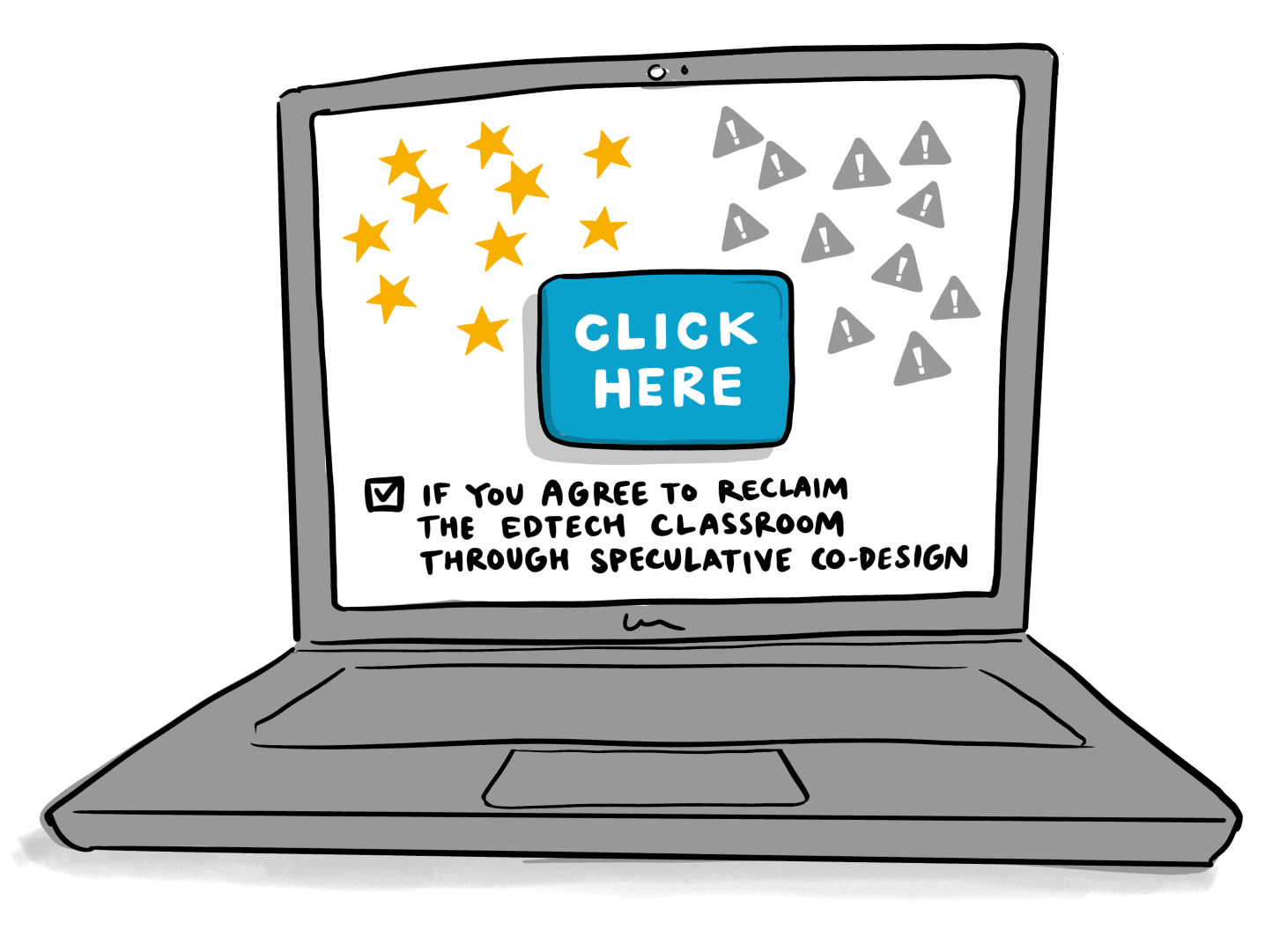
Michał Wieczorek (University College Dublin), Eamon Costello (Dublin City University) and the Civics of Technology are excited to announce a new and revolutionary initiative in the field of critical edtech studies: the Click Here If You Agree (To Reclaim the Edtech Classroom through Speculative Co-Design) workshop, now available as an Open Educational Resource (hosted at https://doi.org/10.5281/zenodo.20538721 and on the Civics of Technology curriculum page).
The imagination-powered workshop aims to supercharge the discussions about the language we use to describe educational technology. Through groundbreaking creative and collaborative activities, workshop participants benefit from the opportunity to develop marketing and compliance pitches for familiar classroom objects. Newest research from University College Dublin has proven this to be an innovative new method for equipping participants with transformative skills to embrace, rediscover, repurpose and critique the dominant narratives that shape our understanding of digital educational technology.
“I felt like I was really working during this workshop. It was very moving. It was not a sit-on-your-ass-shop.”
Workshop advocate and Civics of Technology co-executive director Marie Heath in personal communication to Costello.**
Following prototyping at a symposium at the University of Utrecht, the project received seed funding from the ADAPT Centre, a leading digital technology research centre in Ireland (the funding amount could not be disclosed due to reasons of confidentiality, but rest assured it is unprecedented). This allowed the workshop developers, Wieczorek and Costello, to work with Bryan Mathers of Visual Thinkery, a key innovator in the field of digital illustration whose drawings and doodles have brought life to a wide range of educational initiatives that remain actively alive. As Wieczorek put it, “Bryan really helped this project achieve its full potential. He instantly understood the radical nature of our vision and created state-of-the-art illustrated worksheets that showcase the playfulness and effortless humour embedded in the workshop, while also seamlessly introducing the participants to the one-of-a-kind active activities and offerings that we have on offer.”
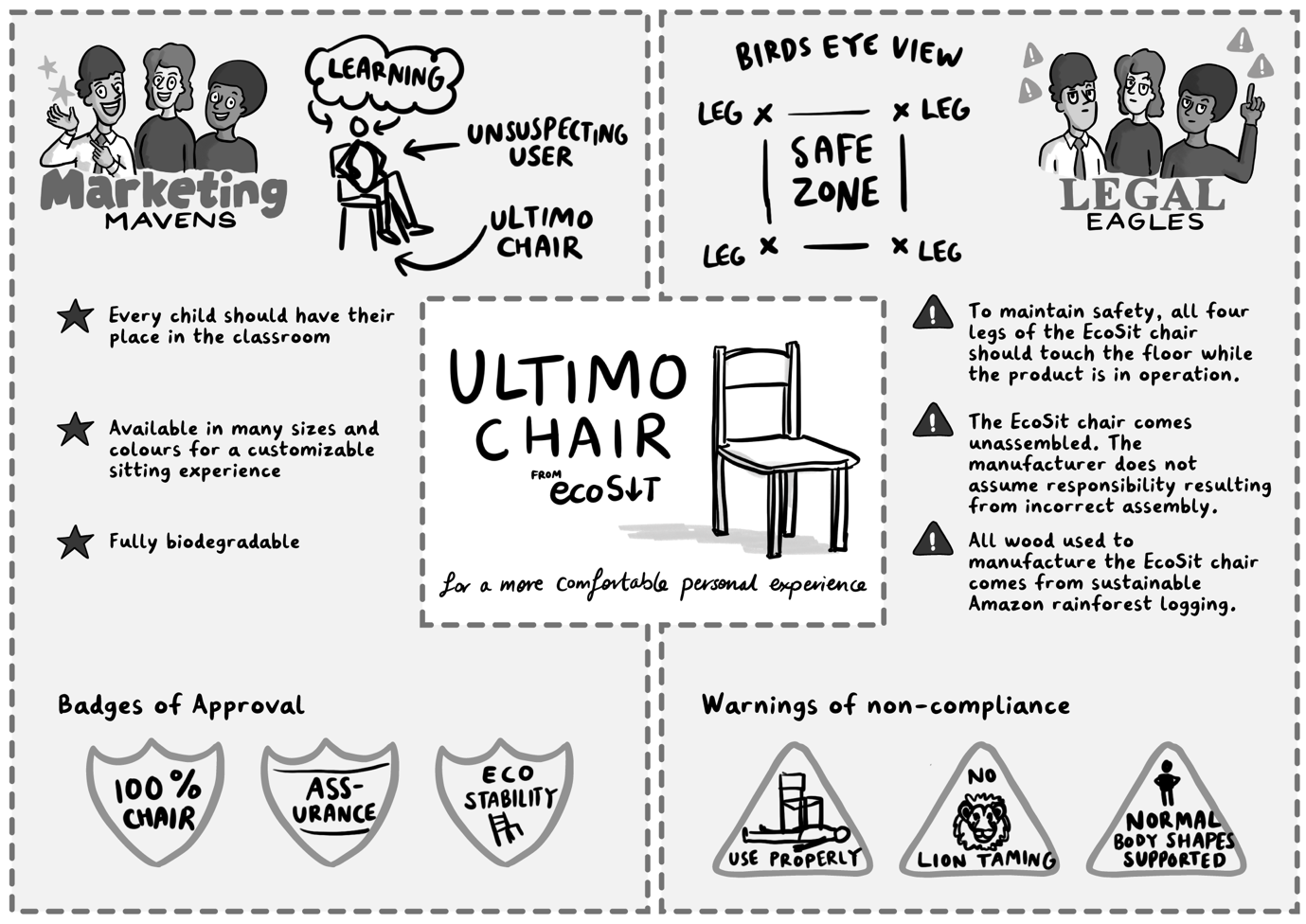
Artist’s rendition of the results that can be expected from the workshop. Credit: Bryan Mathers
Running at just under 90 minutes, the Click Here workshop begins with an engaging and witty presentation that outlines the core ideas of the activity and puts participants to work on two fully synergistic tasks. First, they are invited to imagine a world in which everyday classroom tools and objects never existed. What promises would sticky notes bring to education if they were invented today? What made the originator of the first multiple choice quiz excited about the idea? How to sell educators on the move from clay tablets to erasable whiteboards? Speculating about such alternative histories allows participants to rediscover their excitement for familiar classroom objects and the educational practices they enable. It also makes it possible to explore the shortcomings of digital tools by ridiculing the hyperbolic language used to sell their benefits.
A word of caution: unbridled enthusiasm about innovative educational visions can lead to disastrous consequences. As Costello stresses: "Please harness your ideas ethically and responsibly, like you were squeezing toothpaste out of a tube. Just visualise squeezing from the bottom not the middle of the tube because once the toothpaste is out of the tube it’s like trying to fight fog with one hand."
Wieczorek expands on this point: “We cannot assume liability for any harms and lack of understanding that arise when participants fail to follow the instructions given to them and outlined in the user manual.” Similarly, during the second half of the workshop participants are asked to reflect on the risks that may arise through the use of the products marketed during the workshop, and to come up with terms of service and legal disclaimers that should accompany the tools. While we may be used to the legalese that obfuscates the rights and responsibilities associated with digital edtech, all classroom objects require us to internalise the rules surrounding their use and to accept the educational visions that they make possible. The workshop activities are intended to make these rules, these vision and their constraints explicit. What teaching practices do we proscribe by equipping every classroom with a blackboard? What terrifies educators the most in interactive orals? What hazards introduced by the photocopier have we learned to accept and ignore?
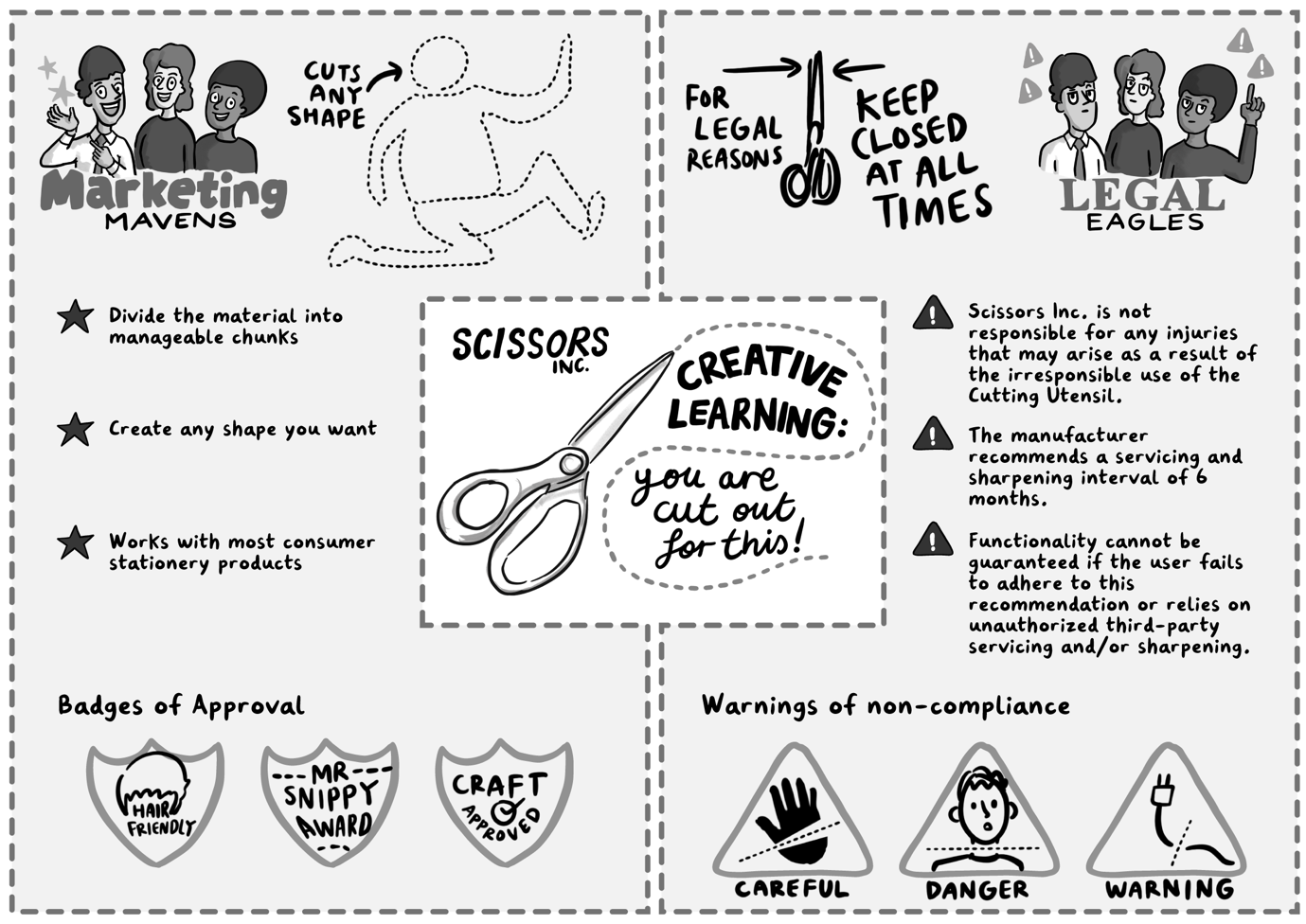
Artist’s rendition of the results that can be expected from the workshop. Credit: Bryan Mathers
The workshop, as facilitated by Costello and Wieczorek (also known as Wieczorek and Costello) underwent rigorous trails at four European universities (University of Utrecht, Vrije Universiteit Brussel, University of Gothenburg and University College Dublin). It has proven a great success and received rave reviews from key stakeholders in educational technology. One participant listed it “among the most productive and good fun things I've done all year”, while others called it “inspiring”, “thoughtful, beautiful, and engaging” and even “nicely done”. To meet popular demand and numerous requests to run the workshop at educational institutions across the globe, Wieczorek and Costello partnered with Civics of Technology to democratise access to this educational innovation and release workshop materials as an Open Educational Resource. Commenting on the partnership, Civics of Technology co-executive director Jacob Pleasants noted that the Click Here if You Agree workshop is uniquely aligned with the mission and values of the project as “this is exactly the sort of thing we'd love to disseminate on our website”.
The included presentation, user manual and fully personalisable worksheet contain rich examples and detailed instructions on how educators can host the workshop in any learning environment. Our data indicates that thanks to its no-cost, adaptable and cutting-edge nature, Click Here if You Agree is poised to become the most popular critical edtech workshop on the market by 2035. Early adopters are able to instantly deliver meaningful learning value and harness the benefits of this novel approach to creative and collaborative learning through speculative co-design.
So don’t wait! Discover the joy of playfulness, co-creation and speculation by running the workshop in the comfort of your home or classroom. Available now for free from Civics of Technology and other select distributors.*
*The workshop developers reserve the right to let anyone re-use, re-purpose, adapt and redistribute the workshop resources. The workshop developers cannot guarantee that the revolutionary benefits discussed in this press release will materialise in practice. You run the workshop at your own risk. Please reach out to us if you wish to know more (we are skilled at using email).
**While names have not been changed to protect the innocent, quotes attributed to the innocent may or may not be largely fabricated.
You can access all the workshop materials at https://doi.org/10.5281/zenodo.20538721.
If you would rather participate in the workshop in your very own person, please join our showcase event at the European Conference on Educational Research at the University of Tampere, 18-21 August 2026.