Comparing Human and AI Soundscapes
How do we understand ourselves and our community through sound?
How does AI describe our community through sound?
What do we notice about our community when AI describes its sounds?
Summary
This lesson on sound journals, community, and placemaking invites students to compare the way they describe their community with the way AI describes their community. The lesson has three main activities. Click on the links below to jump to each activity.
Part I: Sound Journal Activity
Part II: Class Created Collage of Community Soundscapes
Part III: Comparing the Collective Soundscape to an AI Generated Soundscape
Extension and Connections: Soundscapes Around Town
Background
This lesson is inspired by Stephanie Smith Budhai’s and Marie Heath’s book, Critical AI in K-12 Classrooms: A Practical Guide for Teaching Justice and Joy. In the book they celebrate the joy of Black community homeplace-making, noting that collective and embodied memory is essential to the practice. To highlight the differences between deeply rooted community versus a machine generated description of community, they draw on Kathrine McKittrick’s work on Black geographies. McKittrick emphasizes that place-making in Black communities encompasses the bodies of the human inhabitants and the landscape of the place, the role of ancestral history, and the power of collective memory. Budhai and Heath contrast the complex vitality of human communities against the limited, disembodied, and machine approach of AI “imagined” communities.
This lesson leans on the spirit of Budhai and Heath’s work to extend the idea that richness of community can never be fully contained within the algorithms of a machine. The aim of this lesson is to contrast the aliveness, community, and creativity necessary to creating homeplaces against the predictive algorithms and encoded oppression of AI generated descriptions of community. This lesson also serves to strengthens student relationship to and appreciation of their community. You can read more background and view potential adaptations to the lesson in this corresponding blog post.
Model how to create a sound journal. Students can write down sounds or record sounds.
Ask students to spend a day adding entries to their sound journal.
Lead students in individual or small group reflections to begin to notice the different sounds in their lives. You could ask: Whose voices are present? What are the loudest sounds you hear?What are the quietest sounds you hear? What are the times when the day is louder?What are the times when the day is more quiet? What do you hear the most during your day? Maybe you hear mostly people? Or music? Or vehicles? Or animal sounds? Or something else?
Lead students in individual or small group reflections about how different sounds make them feel. You could ask: What is your favorite part of your day? How did it sound during that time? What sounds make you worry? What are the sounds of comfort? What sounds make you feel excited?
What do we notice about our day when we listen to it?
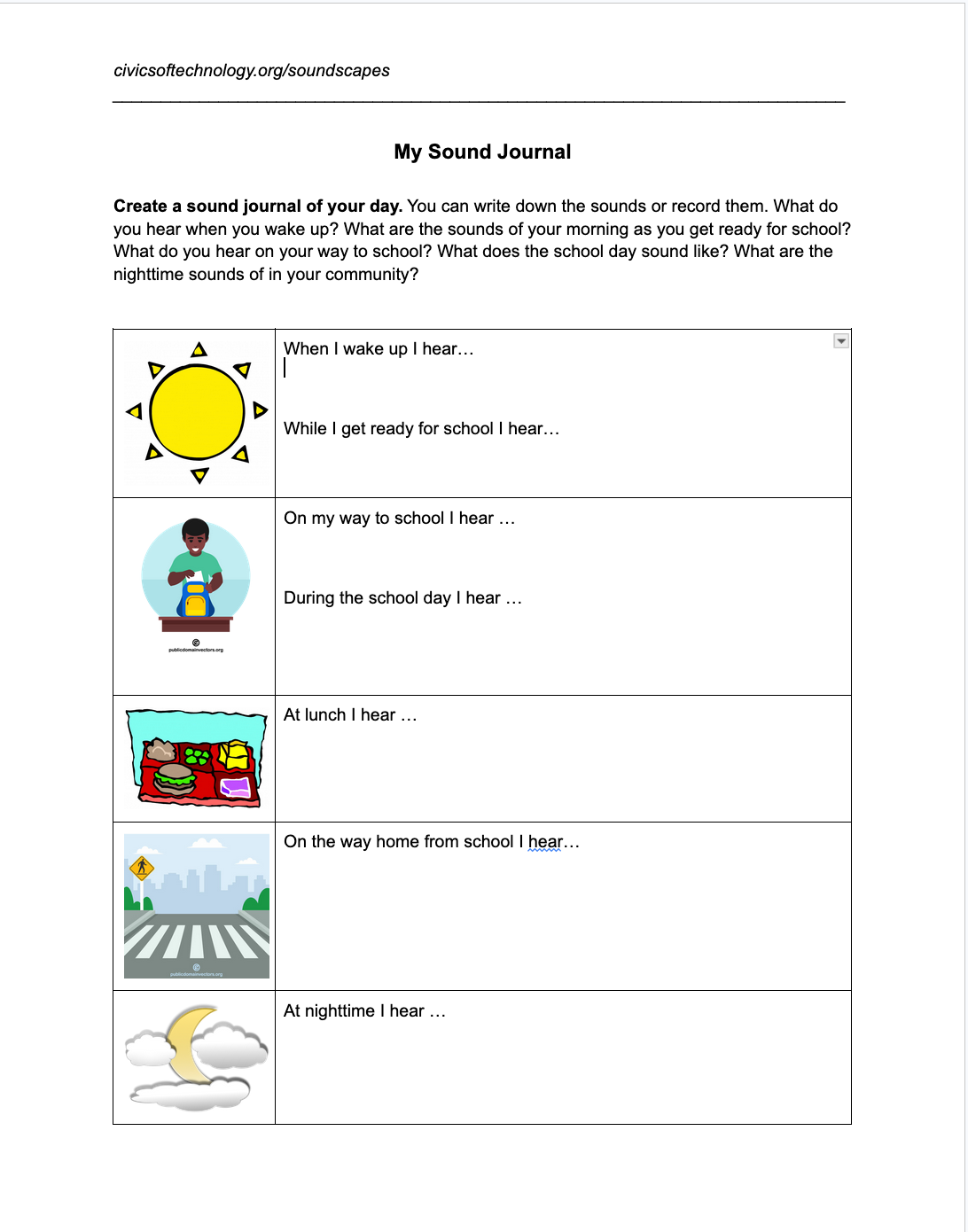
Part I: Sound Journal Activity
What do we notice about our community when we listen to it?
Part II: Create a Collage of Soundscapes
Students work together as a whole class to model the soundscape of their community. This whole class project could take many forms.
Make a word cloud of the sounds they hear every day
Draw or cut out pictures of sounds, and tape them on a wall in the classroom, or on a school bulletin board.
Map their sounds onto a oversized political or physical map of the community served by the school. This could also be a digital mapping using uploads of recorded sounds overlaid on a digital map.
Create a podcast of recorded sounds. Invite the students to suggest how the sounds should be organized. Would they prefer to order the sounds chronologically (e.g. all morning sounds from all students, then all school day sounds)? Would they like to order the sounds by decibel level (e.g. group the quiet sounds together, group the loud sounds together)? Could they group the sounds by feeling (e.g. sounds that bring joy, sounds that cause anxiety)?
Create a collage of written or drawn sounds. Like the podcast, invite students to suggest how the sounds should be organized.
Lead the students in a reflection of the collage and the processes and choices they used to create it.
Give each student 3 sticky notes. Ask them to name three adjectives that describe their community. Write each on a sticky note. Add each note to the collage.
Lead students in a discussion around the question, “What do we notice about our community when we listen to it?

Part III: Compare the Collective Soundscape to an AI Generated Soundscape
Prompt a generative AI to describe what it might hear during the day in your school community zipcode(s).
Ask students what do they notice, and what do they wonder, about the ways AI described their neighborhoods.
Lead students in a discussion to compare and contrast the AI soundscape and the class soundscape.
Ask students to hypothesize why the soundscapes may be similar or different.
Create a student list of their wonders about the AI technology.
Extension: Soundscapes Around Town
How do other communities describe themselves through sound?

Ask other schools in the area to complete Parts I-III of this activity.
Take a field trip, host a video conference meet-up, or organize a traveling community visit night to compare soundscapes, AI generated soundscapes, and wonders about AI technologies.