by Dan Krutka and Marie Heath with Danielle Peck
When we first developed the Critical Technology Quotes, we sought to create a simple entry point for students to gather a range of critical perspectives on technology that challenged common hype and progress narratives. The activity asks students to engage with diverse perspectives on technology ranging from Karl Marx's observations about the hand-mill and steam-mill in 1847 to Meredith Broussard's 2023 definition of technochauvinism. When the activity is taught in person, students walk around the classroom reading quotes posted on walls, adding comments or drawings next the quotes, discussing which ones resonate with them, and considering what these perspectives might mean for how they live with technology today.
The activity has become one of our most popular resources at Civics of Technology. Educators have shared with us that they use the activity to encourage a technoskeptical thinking where technology itself becomes an object of inquiry rather than simply tools we use. Students, we've learned, have a lot to say about technology and this provides an opportunity for them to share their own concerns.
Now, as the artificial intelligence hype train continues to chug along, we believe there was a need for an AI-specific activity. We are excited to introduce the Critical AI Quotes Activity. Marie Heath and Dan Krutka developed this initial activity, but we have updated and added resources from community member Danielle Peck, who simultaneously developed her own activity and resources. This new activity provides educators with a focused lens for critically examining AI technologies specifically.
Why AI Needs Its Own Critical Examination
While our original technology quotes activity certainly works for thinking about AI (and includes a couple recent quotes specific to AI), rapid efforts to integrate AI tools into education demands more focused attention. Since ChatGPT's public release in late 2022, schools have been bombarded with AI hype and marketing. Unlike earlier educational technologies, AI systems operate in ways that hide much of the material and cultural production that go into them, as one of our quotes makes clear:
…AI is neither artificial nor intelligent. Rather, artificial intelligence is both embodied and material, made from natural resources, fuel, human labor, infrastructures, logistics, histories, and classifications. AI systems are not autonomous, rational, or able to discern anything without extensive, computationally intensive training with large datasets or predefined rules and rewards. In fact, artificial intelligence as we know it depends entirely on a much wider set of political and social structures. And due to the capital required to build AI at scale and the ways of seeing that it optimizes AI systems are ultimately designed to serve existing dominant interests. In this sense, artificial intelligence is a registry of power.
— Kate Crawford (Academic), Atlas of AI: Power, Politics, and the Planetary Costs of Artificial Intelligence, 2021
Generative AI technologies are trained on massive datasets that amplify existing social biases (see Warr & Heath, 2025). They are threatening fundamental practices of learning, from how students research and write to how teachers assess and provide feedback, as another quote states:
Letting a robot structure your argument, or flatten your style by removing the quirky elements, is dangerous. It’s a streamlined way to flatten the human mind, to homogenize human thought. We know who we are, at least in part, by finding the words — messy, imprecise, unexpected — to tell others, and ourselves, how we see the world. The world which no one else sees in exactly that way.
— Margaret Renki (Writer), “I, Human,” New York Times, 2025
And unfortunately, AI technologies are being deployed at a move fast and break things pace that does little to attend to the concerns from communities affected by them.
The Critical AI Quotes Activity provides a structure for students and educators to slow down and think together about these developments. Our quotes invite participants to consider what different people, ranging from Ada Lovelace and Joseph Weizenbaum to Timnit Gebru and Joy Buolamwini, have observed about AI and its collateral, unintended, and disproportionate effects. We hope the quotes we've selected for this new quote activity reflect the complexity of the problem.
Running the Activity in Your Classroom
The Critical AI Quotes Activity follows the same format as our original technology quotes activity. Educators can print the quotes and post them around the classroom for a gallery walk, or adapt the format for their specific context. The slides are available for download and editing on the page. Students read the quotes and consider:
What do you believe each quote means?
How does the time and place from which it originates affect its meaning for today?
Which quote most resonates with you—for better or worse?
Students jot down their responses and then discuss them with partners or small groups. The activity works well as an introduction to a longer unit on AI, as a standalone discussion prompt, or as a way to process current events related to AI in education or society. The last slide in our slide deck adapts the activity with simplified quotes for younger students.
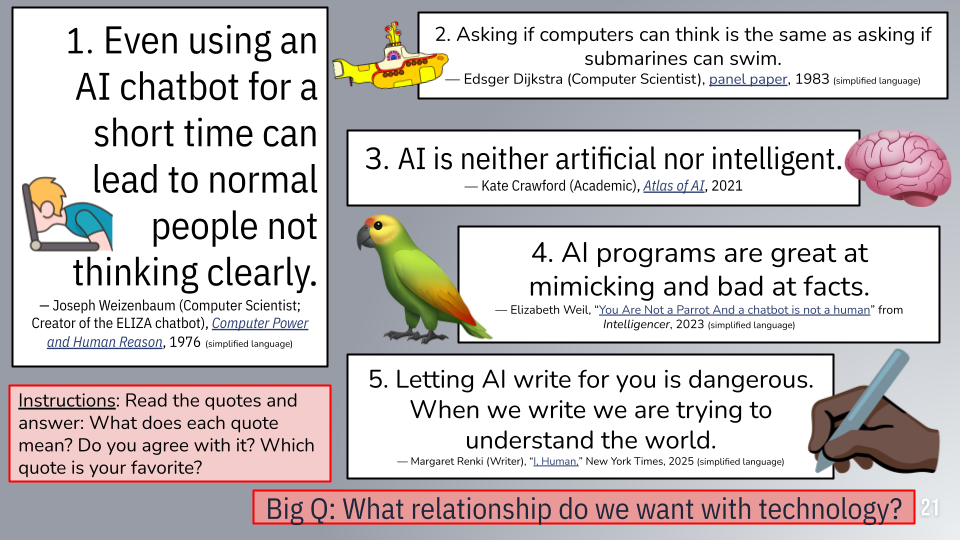
Slide with simplified quotes that can be used with younger students
Danielle’s Contribution
One of the most rewarding aspects of the Civics of Technology project has been the community that has formed around it. Educators across the country and beyond use our resources, adapt them for their contexts, and share back what they learn. This reciprocal relationship has enriched our work.
The Critical AI Quotes Activity exemplifies this type of collaboration. While Marie Heath and I were developing our version, Danielle Peck, a member of our community, was independently creating her own Critical AI Quotes activity. When she reached out to share her work, we were thrilled to discover the overlap and the unique contributions she had made. We've incorporated quotes from Danielle's collection into our activity, and we're linking to her slides so educators can access both versions and choose what works best for their students. Danielle explains her resources here:
As a professional learning specialist who works with educators across the state of Michigan, I often find myself asking, “How can I encourage educators and their students to engage in Critical AI Literacies?” Over the past two years, I’ve explored possible answers to that question by creating and sharing several presentations and other learning experiences. This summer, I drew inspiration from the original Critical Technology Quotes activity and planned an activity that features critical AI quotes.
The activity is very similar to what Dan and Marie have put together, with a few differences. Instead of one set of slides, my activity contains two:
Presentation Slides: Intro to Critical AI Literacies Through Quotes
This set of slides provides an introductory frame, a concluding activity, and resources for further exploration.
I’ve included explanations, context, and experience in the speaker notes to help make sense of the slides.
The deck begins with a grounding definition of AI, adapted from a podcast episode with Timnit Gebru. I post this definition on the wall, alongside the quotes.
After that, the deck contains one quote per slide, with sources listed in the speaker notes.
When I present, I print these on 11 "x 17" paper and tape them around the room for educators to write and draw on during a gallery walk. I also print a smaller set and place them at a table for folks who can’t move around the room. I make a digital copy available for accessibility purposes, as well.
When I present, educators participate in the activity and then receive the materials above so they can replicate or remix it for their classroom or other working context.
So far, I’ve had the opportunity to present this at a few different schools and conferences. Wherever I go, educators have a lot to say in conversation with the quotes. I’ve been most struck by one recurring theme that has emerged: many feel that their own critical thoughts about AI have been ignored by decision-makers.
This activity provides a space to express that, recognize solidarity (with the thinkers who created the quotes and with other folks in the room), and discover new critical ideas.
We have added Danielle’s resources to our Critical AI Quotes Activity page.
Ongoing Development
We encourage all educators who use the Critical AI Quotes Activity to share back with our community. Which quotes sparked the richest discussions? What questions did students raise that surprised you? What other quotes should we consider adding? You can use our Contact Page to share your experiences or ideas with us as we continue to update our resources based on feedback.
We hope the Critical AI Quotes Activity serves an invitation to continue critical conversations about AI in your classroom. As Margaret Renki reminded us in the quote above students will encounter: "We know who we are, at least in part, by finding the words—messy, imprecise, unexpected—to tell others, and ourselves, how we see the world. The world which no one else sees in exactly that way." In a moment of AI hype, helping students find their own words, their own perspectives, their own questions matters more than ever.