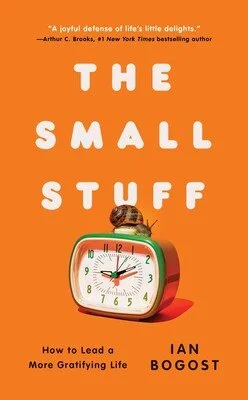
The Small Stuff: How to Lead a More Gratifying Life
Ian Bogost, 2026
Simon & Schuster
Review by Jacob Pleasants
My point of entry into Ian Bogost’s writing was Persuasive Games, his 2007 book about videogames (a topic that is quite dear to my heart, despite the fact that I rarely play anything these days). What I found most compelling about that book was Bogost’s sensitivity to the ways that technologies influence us on a very deep level. Video games are, of course, specifically designed to give us (the players) certain experiences. But those experiences are not mere diversions. They affect us, they change us. Like all technologies, they are not neutral.
The ostensible content of Bogost’s latest book, The Small Stuff, is quite a bit different, but I found a similar sort of resonance with its arguments and themes. While it is not solely a book about technology, a primary focus is how our everyday experience with the material (technological) world has profoundly changed, and how that has in turn changed us. Bogost wants us to pay attention to those changes in our seemingly mundane experiences, and he offers a set of conceptual tools for doing so. In this respect, it’s not so different from the tools he provides to help us pay better attention to video games.
On “Small Stuff” and Gratification
The feeling of the keys on my keyboard. The smoothness of my glass of water. The precise feel of my kitchen knife. The sound of my bicycle’s tires rolling across the pavement. This is the raw stuff of experience, the way that we encounter the world moment-by-moment. When it comes to trying to live “the good life,” we don’t often regard these small experiences as being terribly important, especially in comparison to “big” stuff like our goals, values, hopes, dreams. But Bogost wants us to reconsider that dismissal. Fleeting as our experiences of the small stuff might be, the texture of our lives is far more meaningful than it is often assumed to be.
Some distinctions: Bogost asks us to differentiate happiness, satisfaction, and gratification. Happiness is a long-term state, an overarching contentedness that tends to be the focus of much of our decision-making. Satisfaction is not quite as global, but is also a longer-term state. It comes about when we complete projects and achieve our goals, both small and large. Gratification is a short-term, positive state that is coupled to our immediate experiences and sensations of the world: a delicious bite of food, a pleasant aroma, a beautiful vista, a lovely noise. There are all sorts of books written about happiness and satisfaction. This book is about gratification.
Gratification, Bogost argues, has unjustly been given a bad rap. Too often, we are told that we must forego gratification in favor of satisfaction and happiness - those more long-term, vaunted goals. No doubt, there are occasions when gratification in the present can be at odds with one’s future. But that is far from an inevitability, and there is nothing inherently virtuous in foregoing gratification. Why should we not enjoy the experiences of life?
The War on Small Stuff
As a piece of self help, Bogost’s suggestion to “enjoy the small stuff” is not exactly profound. Stop and smell the roses, sure, sure. The subtitle of the book does suggest a bit of self help, but that isn’t quite where things go. Having established the basic terminology, Bogost argues that there has been a steady whittling away of the small stuff and the gratification that accompanies it. This has been a technological/cultural (in combination, not separate) process rooted in a quest for “rationality.” That’s my word, not his; Bogost writes of convenience, efficiency, and the like. Bogost calls the overall process of small stuff-elimination “dematerialization.” Essentially, we are becoming separated from our experiences of the world.
An example. Bogost discusses the change in cars from manual transmission to automatic and now to the electric motor (incidentally, it was this example that inspired Bogost to write the book). Each step of the way, we become a little farther removed from the physical experience of operating the car as a piece of machinery. And this is to say nothing of the quest for the self-driving car. We have definitely given up something with the loss of the manual transmission. Many driving enthusiasts will speak fondly of the experience of operating a manual (gratification). Does this mean that we should bring back the manual? Not exactly. The benefits of an automatic transmission or an electric motor could be very much worth giving up the (debatably) valuable driving experience that the manual transmission offers (I would argue they very much are!). The point here is not that we should cling to the manual transmission, but simply that we should recognize what we are giving up.
Or consider the concert ticket, once a physical thing but now a digital entity. In material form, the concert ticket offered a wealth of sensory and social experiences that have been dematerialized by the e-ticket. The digital ticket is, no doubt, convenient in many ways (you can’t lose it!). But we give something up for the benefits. Maybe something worthwhile. Writing with quill and ink also comes to mind (my example, not Bogost’s). No doubt there is a sensory experience to working with those materials (especially if high quality) that would be quite gratifying. It’s not an experience I’ve ever had. Writing with a pen has its own pleasures as well, but it’s not the same. That said, I will take the convenience of the ballpoint pen just about any day.
I should point out that Bogost is clearly not arguing that technology inherently erodes experience. Quite the opposite: many (if not all) of the gratifying experiences that Bogost describes involve technologies in some fashion.
In advancing this argument, Bogost is in good company. Christine Rosen’s The End of Experience makes similar claims about our seemingly relentless impulse to eliminate the “small stuff” of life. We could even look to Albert Borgmann’s Technology and the Character of Contemporary Life. What is distinctive about Bogost’s approach is the way that he brings design sensibilities to the issue. Dematerialization is something that people have chosen, and we could choose differently. Doing so doesn’t require “frictionmaxxing” or abandoning convenience. But it does require that designers think about the lived, sensory experiences of people.
Objections
There’s a common pitfall in the kinds of arguments that Bogost makes. It’s easy to drift into a wistful nostalgia, praising the experiences of the past while dismissing those of the present. Is it really the case that driving a manual transmission car is more gratifying and less “dematerialized” than driving an electric? It’s definitely a different experience, but is it “lesser?” All our experiences, no matter how digital, are material. Poking at a touch screen is just as much of a physical experience as pushing physical buttons. Or is it?
I would have liked Bogost to engage with this question more deeply and directly. He mostly relies on an intuitive version of his argument, citing plenty of examples that “feel” dematerialized. I largely share Bogost’s sensibilities and thus found myself agreeing with many (if not all) of his examples. But therein lies the rub. Is dematerialization a wholly subjective phenomenon, or is there an underlying reality?
Another theme I would have liked to see developed further is why so many of our technologies have moved toward dematerialization. If this is not inevitable, even for digital technologies, then how did we get here? Bogost touches on this briefly when discussing specific cases. A good example are automatic (sensor-controlled) restroom technologies (toilets, faucets, soap dispensers, etc.). Not only do these technologies remove sensory experiences, but they don’t even function well for those using them (and aren’t even any more hygienic or water-efficient), so why do they exist? Well, they may not be more efficient for users, but they are more efficient from a business owner perspective, primarily because they don’t require as much maintenance or cleaning. There’s a reason why we don’t populate our own bathrooms with this crap!
A More Gratifying Life?
As promised by the book’s subtitle, Bogost has some suggestions, which make up the back 20% of the book. They are unobjectionable, and also pretty much exactly what you’d expect. In a nutshell: the world, for all its dematerializing tendencies, is still full of great stuff that we ought to spend more time experiencing and enjoying. Sure. I do have to wonder how much of this “self help” chunk of the book came at the publisher’s behest. Whatever its origins, it is eminently skippable.
I might offer this take-away, though, when it comes to how we live and work. Opting for more sensory-rich, material, and relational approaches to our lives is good in itself. Those experiences are gratifying, and that’s a good thing. Too often, we try to rationalize and justify our actions by appealing to abstractions. For example, I bike to work because it is low-carbon, for the exercise, so I don’t contribute to congestion, etc. Fine reasons, those. But if you really pressed me, it’s because biking is simply an enjoyable embodied experience. If it were unpleasant, if it brought no gratification, I probably would not do it. Of course, part of life is learning to appreciate experiences like biking, cooking, fixing, knitting, and all sorts of other activities. What we find gratifying is acquired. And that’s something worth thinking about further.