Questioning AI with Future Teachers
Civics of Technology Announcements
Next Tech Talk: Our April Tech Talk will feature the theme of “Caregiver Resistance to (Ed)Tech.” It will be on Wednesday, April 15 at 8:00 PM ET. You can register here.
Upcoming Book Club: We’re reading The Digital Delusion: How Classroom Technology Harms our Kids’ Learning - And How to Help Them Thrive Again by Jared Cooney Horvath. Join us on Wednesday, April 22nd at 7:00 PM ET. You can register here. You can read more about our mixed feelings and reasons we’re reading this book in this blog post.
AERA Meetup: Meet up with us at AERA! Friday, April 10, 2026 4:00-5:30 PT at the Yard House in LA. Please RSVP for the event here.
By Jacob Pleasants, Dan Krutka, and Allie Thrall
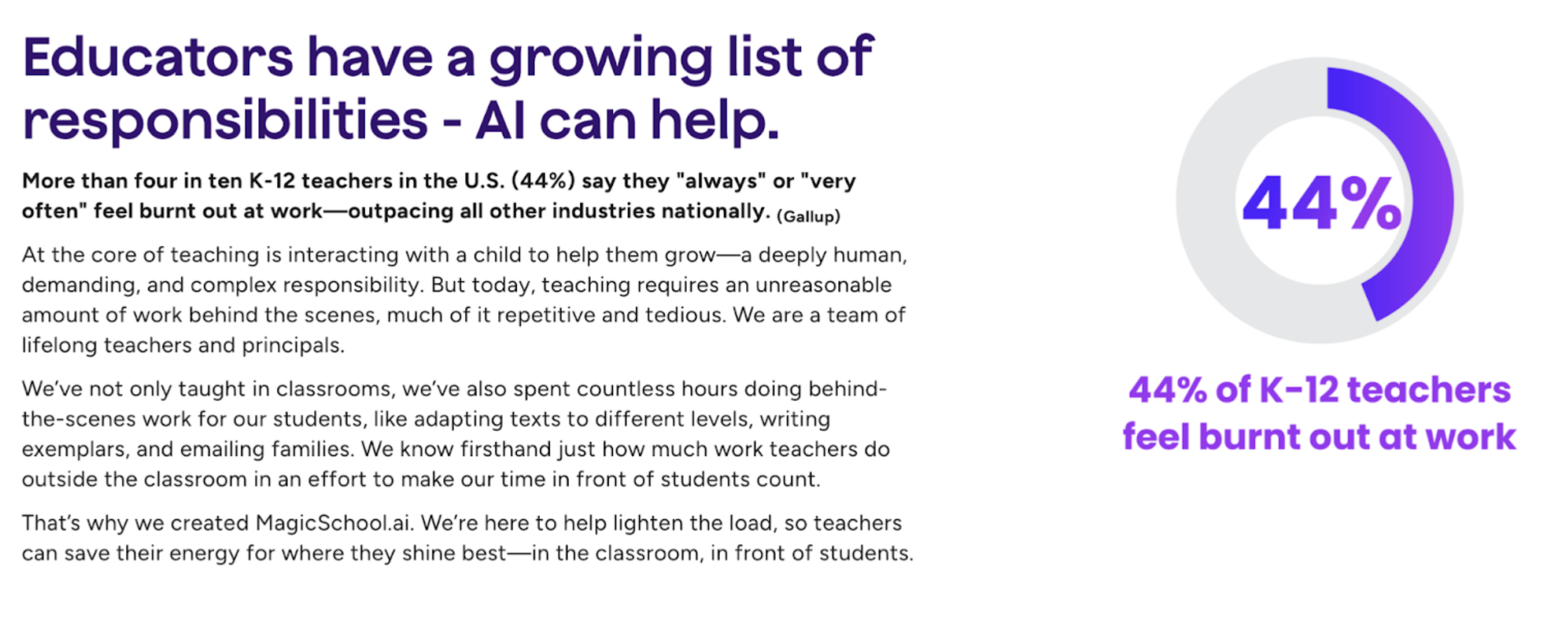
Teaching is a hard job. From attending to the learning of a class full of young people to grading stacks of assignments, it’s a lot of work, which makes it particularly susceptible to claims about technologies that purport to lessen this load. Of late, some big claims have been made about the capacity for AI to “magically” ease teachers’ workloads. There’s a study by Gallup and the Walton Foundation that claims AI is saving teachers who use it as much as six weeks per year (a finding of which we are quite skeptical). Even if not all time savings are quite so superlative, efficiency is commonly cited as one of the main benefits of AI for teachers. Not surprisingly, it’s the main part of the sales pitch for teacher-facing AI platforms (e.g., MagicSchool, see below).
There are many reasons to doubt the labor-saving promises of AI for teachers. Multiple studies of automation in classrooms have found evidence of intensification rather than an easing of teacher burdens (see, for instance, Selwyn et al., 2025 and Wang et al., 2026). We can also look to historical studies of technology and labor, especially Ruth Schwartz Cowan’s classic, More Work for Mother (a one-time CoT book club book! And also the subject of an inquiry created by Allie Thrall and Paige Arnell).
Cowan showed how household technologies, even while making certain discrete tasks easier or faster, had complex and often unexpected impacts on women’s labor in the home. In short, despite the proliferation of household gadgetry, the hours that women worked in the home did not dramatically decline. That’s not to say that it had no positive impact. But the story of “labor-saving” technology, whether in the home or in the workplace, is always more complicated than its proponents would have us believe.
How do we prepare teachers to navigate these complexities when they are bombarded with claims and promises about what various AI platforms can help them do, and how much time it can save?
In our work with future teachers, our goal is not to deny the potential usefulness of AI technologies. We recognize that many current and future teachers already use AI for various purposes, and will probably continue to do so. But we do need them to critically reflect on those decisions, and to question the (labor-saving) narratives around these technologies. In other words, we need them to take a technoskeptical approach when engaging with AI.
So, the three of us decided to team up and develop a technoskeptical inquiry that we could deploy in our various teacher education courses in Spring 2025. And you can now read all about it in our new TechTrends article published this week, which you can access here! Also, for a deeper look at what happened in Jacob’s science methods course, you can read about that in the Journal of Science Education and Technology. Among other things, we had our students look at the parallels between the sales pitch of MagicSchool AI and this lovely advertisement:

Key Highlights & Takeaways
In our article, we provide vignettes from the inquiries we led in our respective teacher education contexts. Rather than standardize the inquiry, we worked together around a shared question – how to engage pre-service teachers in a critical analysis of the time-saving promises of AI platforms – and share resources and insights as we design lessons that meet the needs of each of our varied contexts.
Jacob
Jacob developed his inquiry for multiple sections of undergraduate elementary science methods. He had his students focus on the MagicSchool AI platform and consider its implications and impacts on both labor (does this actually save me time?) and their teaching practice (does this make my teaching better?). While a handful of his students saw time-saving possibilities, most gravitated toward using the platform to assist with lesson planning, a task that many still found daunting, especially for science. However, after the inquiry, many espoused that they would take a very cautious approach, using AI platforms only after exhausting other options. They were wary not only of the quality of AI-generated products, but also of its potentially corrosive impacts on their professional knowledge and skills. The labor implications were not yet top of mind for these future teachers, but the inquiry nevertheless raised important questions about how using AI might impact them as professionals.
Dan
Dan developed his inquiry for his undergraduate elementary social studies methods course. Placing it in the longer history of labor-saving technology hype, his first move was just to open space in class to discuss students’ uses and perspectives on AI. He quickly learned that students’ held varied and complex views, which hardly matched narratives about cheating college students suffering from brain rot. Students’ included environmental concerns and cognitive offloading. Dan always lets his students know that AI use was not required, and he didn’t believe we should ever require it for students so they feel comfortable making their own ethical decisions. However, recognizing that many educators are going to use AI, he embedded technoskeptical inquiry into a pre-existing project so he could think alongside students as they made their choices. In this case, teacher candidates were completing a biography project on Texas historical figures for 4th grade students for which there are few quality elementary resources. He thus sought to help students differentiate between use cases where AI might actually be beneficial to other cases where it did not.
Dan shared with students how he uses AI to translate class materials to Spanish, but he doesn’t just offload the task, he practices his own Spanish by studying the responses and asks fluent speakers to critique the translations. By feeding GenAI programs open access encyclopedia accounts written by historians, students had mixed experiences in GenAI generating “history mystery” narratives that they hoped would be more accessible and appealing to 4th graders. Students shared a mix of interesting narratives with others filled with errors or unappealing narratives. Some used the AI generated text while others discarded it. Regardless, we recognized that while there were some educational benefits to language translations or narrative adaptations of historical texts, these tasks did constitute new labor they would not otherwise have attempted. AI did not simply produce new text, it produced new tasks that required review and modification. So much for saving labor.
Allie
Allie developed her inquiry for her seminar with secondary social studies masters students, who were in their full-time student teaching placements in high school history classes. Given the history context, Allie used the opportunity to model the design and lesson flow of critical historical inquiry by engaging students in three rounds of primary source document analysis questioning the time-saving promises of technology advertisements.
For the first round, she presented the pre-service teachers with primary sources, drawn from Buchanan’s 2016 article “Kitchens of Futures Past.” The primary sources were largely mid-century advertisements for household technologies. What unified them was that they each marketed, not only a product, but visions of the future of household arrangements. With these advertisements, the pre-service teachers questioned: whose vision of the future do these advertisements represent? By correctly assessing that the visions were those of technologists/men, who stood to profit and benefit from these visions of the future, and with 20/20 hindsight revealing that these visions were not only inaccurate representations of how history would unfold, but also regressive visions of social relations by our contemporary standards, they came to question how technologies encode certain visions of the future into our social relations, of which we should be wary.
Having honed this technoskeptical perspective at the distance of mid-century household technologies, the subsequent rounds of primary source analysis applied that same line of questioning to nearer and nearer sociotechnical dynamics, until we reached the sociotechnical dynamics presented in MagicSchool AI advertisements. By then, the pre-service teachers were prepared to parse the modern ads, questioning whether and/or how AI platforms save teachers time, to whose benefit, and at what cost. (Allie is happy, as always, to share her teaching materials should anyone want them!)
Bigger Themes
Across our experiences, we identified important differences. Indeed, learning, much like technology, expectedly differs in different contexts. But, to highlight important patterns we found that:
Our pre-service teachers were cautious toward AI but also interested in examining it and talking seriously about it in our classes. This challenges simple narratives that college students are eager adopters or categorical rejectors of AI technologies. While some of our students may have fit those categories, most took a more complex stance.
Our pre-service teachers gravitated toward considerations of AI’s capacity to complete otherwise untenable teaching tasks, more so than its ability to save teachers time, making this inquiry essential to invite them to critically inquire into this discourse.
Our interactions with pre-service teachers revealed that they were already experiencing emotional concerns about AI and their soon-to-be profession. Given that contemporary teacher educators served as teachers largely before the release of gen AI, we consider this to be an important point of reflection for teacher educators: what burdens is AI already placing on emerging teachers, and how can we understand and support them in navigating them?
Hot Takes Since the Study
While we elaborate on our inquiry lesson designs and outcomes in the article, we wanted to provide our Civics of Tech community with some bonus insights that we have thought about since completing this study a year ago.
First, we have been heartened by the growing body of research investigating the time-saving promises of AI from different vantage points. As cited above, we saw Selwyn, Ljungqvist, and Sonesson’s empirical study showing the excess labor that teachers spend “reviewing, repairing, and reworking” GenAI outputs published as we were engaged in these inquiries. Even a month ago, we were caught by the Harvard Business Review headline that a soon-to-be released eight-month research project studying the AI-instigated shift in work habits of hundreds of tech company employees demonstrated a consistent intensification of work, predicated upon (1) task expansion, (2) blurred boundaries between work and non-work, and (3) more multitasking. Another recent analysis of 164,000 workers’ digital work activity suggested that “AI is increasing the speed, density and complexity of work rather than reducing it.” These are precisely the kinds of rearrangements we are concerned with for the teaching profession, and require analysis alongside in-service and pre-service teachers.
Additionally, we remain concerned about the emotional burdens that AI may be placing upon early career teachers. We considered how this emotional burden may be exaggerating divides between experienced and inexperienced teachers at schools, wherein inexperienced teachers both feel more pressure to adopt the AI systems thrust upon them (potentially intensifying their labor, in addition to other concerns about supporting their deskilling during important learning years), while also feeling concerned about their professional status if teachers, parents, and administrators assume they are using AI. As experienced teachers ourselves, we imagine that, in a K-12 setting, we would be able to take a firm stance relative to AI with less concern about what other people think about our use/non-use. This is not a luxury that new teachers are afforded and to which we must attend.