Caregivers Challenging Ed-Tech in Schools: An Invitation to Engage
Civics of Technology Announcements
Next Tech Talk: This one’s a little different. Our April Tech Talk will feature the theme of “Caregiver Resistance to (Ed)Tech.” It will be on Wednesday, April 15 at 8:00 PM ET. You can register here.
Upcoming Book Club: We’re reading The Digital Delusion: How Classroom Technology Harms our Kids’ Learning - And How to Help Them Thrive Again by Jared Cooney Horvath. Join us on Wednesday, April 22nd at 7:00 PM ET. You can register here. You can read more about our mixed feelings and reasons we’re reading this book in this blog post.
AERA Meetup: Meet up with us at AERA! Friday, April 10, 2026 4:00-5:30 PT at the Yard House in LA. Please RSVP for the event here.
Post by Allie Thrall, Charles Logan, & Tony Talbert
A little over a year ago, we published a blog series exploring the quandaries of “Being a Civics of Tech Parent.” As parents of school-aged children ourselves, we asked: having cultivated a critical eye toward educational technologies, what are we to do in the face of nearly daily reminders of the ways our children’s education is being overwritten by ed-tech? We reflected on our own experiences bristling against school ed-tech policies; we invited other parents to share their testimonials; and, with Phil Nichols, we synthesized the primary concerns shared across our testimonials as (1) screen time, (2) privacy, (3) learning outcomes, and (4) equity. By doing so, we hoped to use the Civics of Tech platform to cultivate a space for parents and caregivers to share resources and reflect on opportunities to turn back against the rising ed-tech tide.
In the year since, it appears caregivers’ resolve to resist ed-tech has only grown. Caregivers have written opinion editorials and open letters to school leadership. Preexisting local, grassroots groups (e.g., Screen Sense Evanston in Evanston, Illinois, and Schools Beyond Screens in Los Angeles, California) and national organizations (e.g., Fairplay for Kids) have received growing recognition. As our April Book Club will soon explore, the 2025 publication of The Digital Delusion by Jared Cooney Horvath is now channeling The Anxious Generation-inspired concerns about the harms of social media on young people’s mental health toward the harms of ed-tech on student learning. Recently, board member, Michelle Ciccone, helped us to extend our thinking about K-12 ed-tech resistance to daycare settings. And, the San Diego Unified Council of PTAs hosted Charles to consider ways to push back against AI technologies in schools. In all, we have been heartened by the growing efforts within and beyond the Civics of Tech community to support caregivers in critically examining and challenging ed-tech in schools.
However, for all the growing attention and action, the motivations and means of this work remain consequentially under-explored. What do caregivers describe as the biggest problems with ed-tech in schooling? What resources and learning have most inspired caregivers to take action to challenge ed-tech? And what actions have proven effective or ineffective and under what conditions, in actuating change? These questions have yet to be systematically explored. What’s more, building a repertoire of effective actions across communities is especially crucial at a time when surveillant school technologies are weaponized against students and their families and powerful actors remain committed to embedding generative AI products into the everyday rhythms of teachers, students, and caregivers.
Motivated by the questions of when, why, how, and to what ends caregivers challenge ed-tech, the two of us, in partnership with Dr. Tony Talbert of Baylor University, have just begun a new research study. Caregivers (broadly construed to include non-parent relatives and guardians) in the United States, who have one or more school-aged children, and who have currently or in the past have challenged ed-tech in schools are invited to participate. The study involves two phases. The first phase asks caregivers to complete a short (~15 min.) questionnaire about the motivations and means of their resistance to ed-tech. The second phase invites interested caregivers to participate in a one-hour interview to elaborate on their experiences and beliefs. The more caregivers participate, the more we learn. If you meet the criteria as a participant, please take the time to complete the questionnaire. And, even if you do not meet the criteria, you can still help. Please share the survey link, this blog post, and/or the embedded flyer widely!
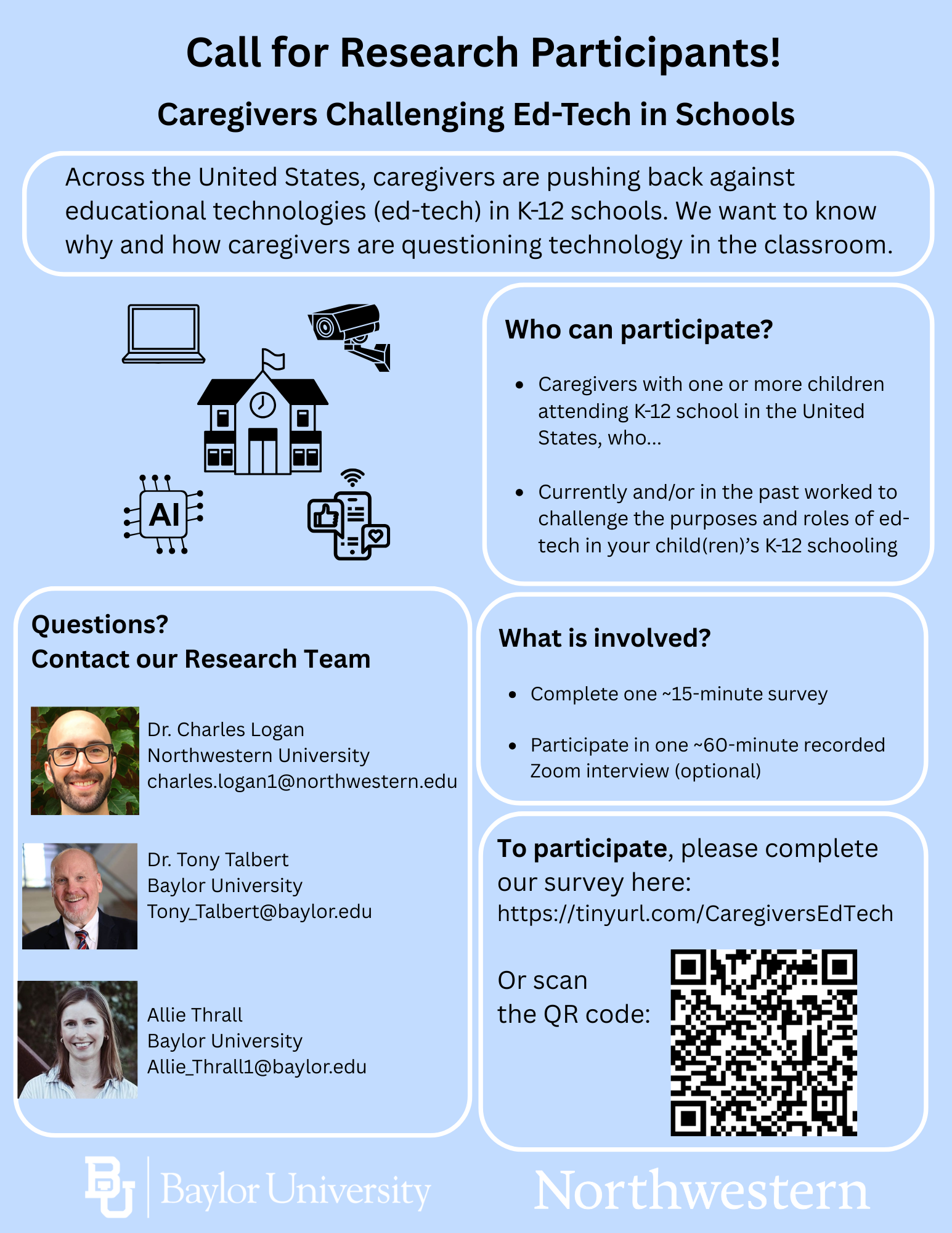
Finally, sticking with our commitment to support these growing efforts, we also invite you to join our upcoming April Tech Talk: Engaging in Caregiver Resistance to Ed-Tech. During this time, we hope for caregivers and non-caregivers–and even your kids too–to gather to share stories, resources, and build connections. The Tech Talk will take place on Wednesday, April 15 at 8pm ET. Register to receive a Zoom link here. We hope you join us in the multi-faceted work of challenging ed-tech in schools!