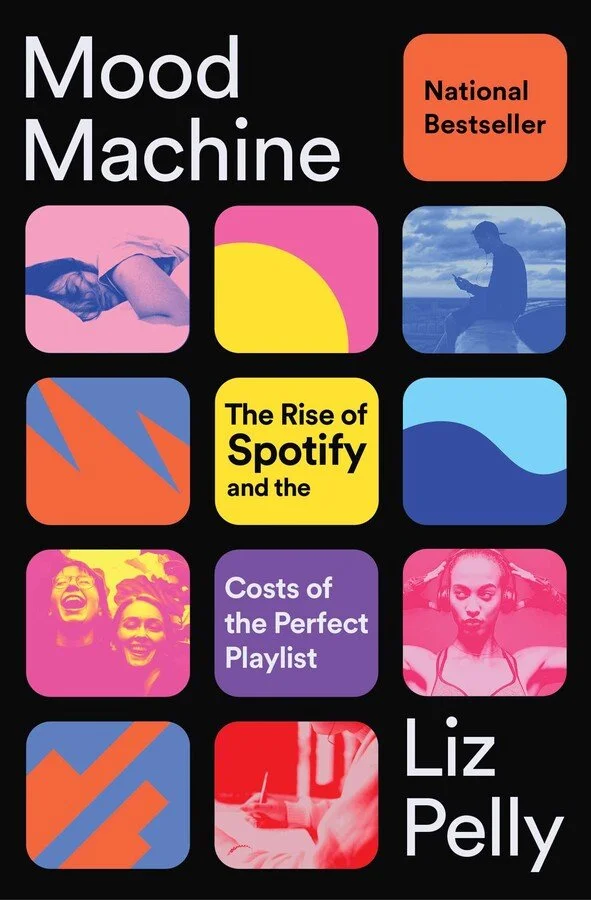
Mood Machine: The Rise of Spotify and the Costs of the Perfect Playlist
Liz Pelly, 2025
Simon & Schuster
Review by Jacob Pleasants
Let me begin by admitting that I do not use Spotify, nor any other music streaming service. My last memory of using Spotify was on a car trip with my then-fiancé and using her account to play some songs that might keep her awake as she drove. That was perhaps 8 years ago. These days, when I want to listen to music, I’m probably in my car and I’ll probably either tune to a radio station or play one of my old CDs (I grew up in the 90s and early 00s, so yes I have a CD collection). As a listener, then, I can’t claim much experience or expertise with what it’s like to engage with music in “the streaming era.”
And yet, I find myself absolutely fascinated by how the technology of streaming has transformed the music landscape, both for artists and listeners. A few years back, I eagerly read Nick Seaver’s Computing Taste, which offered a deep look at how the streaming service technologists and engineers think about music. I have savored the various podcast episodes and journalism pieces I’ve encountered that have spoken to this topic. I think the reason I am drawn to these issues is that there is perhaps no more obvious case of how technology interacts with (shapes and is shaped by) culture. Because what is music, if not a cultural practice through and through?
Liz Pelly’s Mood Machine was pretty much written for me, it seems. It’s a close and deeply critical examination of how Spotify came to dominate and utterly transform the music industry, and the consequences this has had for artists and listeners. Even though the music industry might be a little outside of the typical Civics of Technology scope, Pelly’s critical inquiry has much to offer. As a case study, it is a powerful illustration of one of our bedrock principles: This technology is not neutral, nor are the societies into which it was introduced. Pelly has a lot to teach us about how technology, culture, industry, and power can shape our lives and livelihoods. Considering how many people use music streaming services, this book could be the foundation of some deeply relevant lessons with students at all levels. So, let’s get into it.
Origins
Prior to reading this book, I had little knowledge of how Spotify came to be, aside from it being Swedish. Its founders peddle in very typical tech-company narratives about disruptive innovation, transformation, democratization, etcetera etcetera. Cutting through those tropes, Pelly shows how Spotify began as an ad-tech venture, where music was chosen as a convenient market space for deployment. At its core, Spotify remains true to its origins. Its raison d'être is delivering advertisements to its users. It turns out that streaming music just happens to be a very good medium for ad delivery.
It also just so happened that when Spotify was founded in 2006, the music industry was at one of its weakest points, hobbled by the era of music piracy. The industry had endured Napster and countless other fileshare platforms, including The Pirate Bay - notably based in Sweden. It was a perfect environment for a new technology-mediated model of music delivery that would actually result in payments going to music labels and artists.
Imperatives
Spotify has proven to be a very nimble company, trying out a wide range of models and approaches over its relatively short lifespan, from curated playlists to algorithmic recommendations. As Pelly documents those changes, though, she demonstrates how a core set of imperatives have influenced and guided the company’s evolution. Spotify is in the business of delivering ads; more engagement with the platform means more ads delivered. But on the other hand, music is not free; artists and labels demand compensation for every song that is played. The incentive structure is therefore rather clear: find ways to lower the payments made to music producers while getting users to listen to ever more music. These incentives explain many of the schemes that Spotify has employed over the years. Pelly describes many, but a few standouts really stuck with me:
Playlist Filler: Some music is cheaper than others. It makes sense, then to load up curated playlists with those cheaper tracks. But not too much, because you don’t want your users to start skipping those tracks or disconnecting from the platform. A whole cottage industry arose to manufacture filler content for the kinds of playlists that Spotify was pushing. For the musicians who labored to produce that content, it was steady if utterly unfulfilling work.
The New Payola: Suppose that you are a new artist who is seeking to build an audience. Spotify can promote your latest track and ensure it reaches more eardrums, if you’re willing to accept a smaller royalty for each play of your track. Spotify, obviously, has enormous power to put your track in front of users, so this is rather tempting. And naturally, the users won’t know about this arrangement. But while this might be lucrative if you were the only artist doing it, the whole premise collapses if many artists do so. It becomes an arms race that Spotify wins and artists lose. There was a reason why payola was banned among radio stations!
Consequences
As the preceding examples suggest, the economic imperatives that Spotify has followed have largely been disastrous for artists, especially those who are not in the highest echelons of stardom (i.e., most artists). But this is not just a story of economic exploitation. In its pursuit of profits, the systems and structures that Spotify has put into place have had much more far-reaching cultural impacts.
In a crucial part of the book, Pelly describes how Spotify has leaned into “functional” music: playlists “for the gym” or aligned with certain “moods.” Functional music has a long history, and Pelly recounts the rise of “Musak” as background music for functional spaces, from elevators to shopping malls. Yet Spotify has truly “innovated” in this space, finding ways to insert background music into ever more parts of our days. It’s obviously a shrewd move for Spotify. More listening time = more opportunities to deliver advertisements. Better yet, those “mood” playlists can be absolutely stuffed with low-cost filler and now AI-generated “content” (yes, a shift from “music” to “content”).
This truly is a profound change. It hasn’t just introduced new sounds into new parts of many people’s lives, but has also reconfigured the way that many people engage with music more generally. In short, it has fostered a shift toward music as “background sound,” with listeners surrendering to an algorithm to decide what is played next. Music that is always on and heard but rarely truly listened to or given one’s full attention. Is this background music still “art,” or has it become something else?
Read This Book If…
Even if you are not quite so drawn to this topic as I am, it is absolutely worth your time. Liz Pelly has written a very accessible, compelling, and at times page-turning book. It is deeply researched and filled with insights. Whether or not you are a user of a streaming platform, it will change the way that you think about the current state of music. And it might just compel you to engage a little differently with those artists whose work you value.